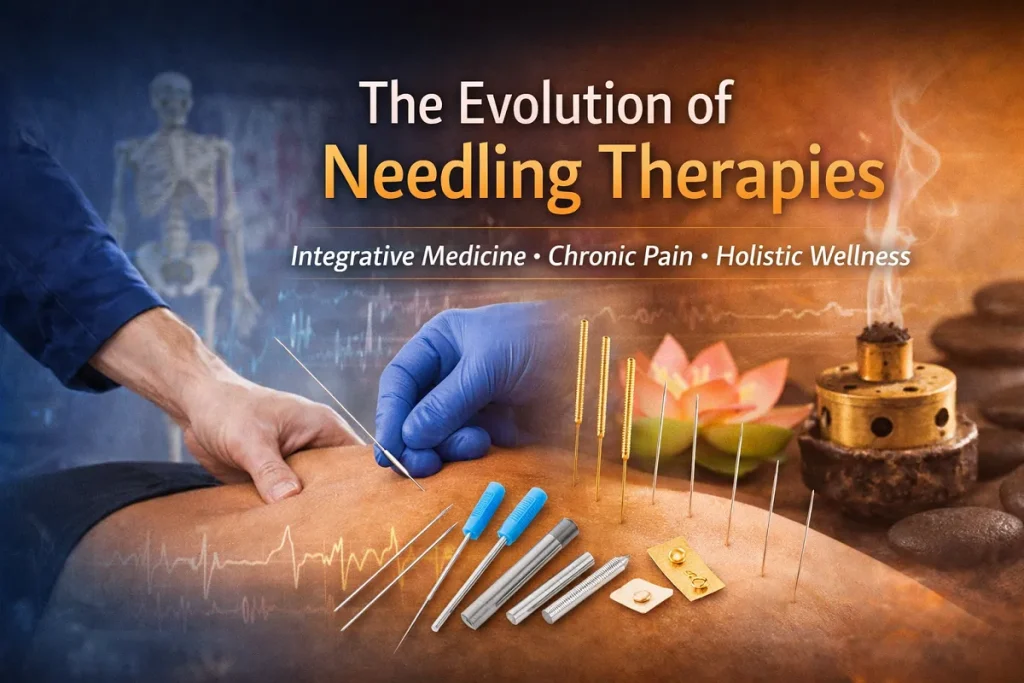
I. Introduction: The Evolution of Needling Therapies
The landscape of pain management and holistic wellness has experienced a dramatic shift over the last two decades. Integrative medicine is no longer on the fringes of healthcare; it is a central pillar. As healthcare providers look for minimally invasive, drug-free methods to treat chronic pain, inflammation, and systemic imbalances, the reliance on precision medical consumables has skyrocketed.
At the center of this movement is a highly engineered, seemingly simple tool: the filiform needle. However, the application of this tool has sparked a fascinating clinical and philosophical discussion—the dry needling vs acupuncture debate. While the instruments used in both practices may look identical to the untrained eye, the diagnostic frameworks, clinical objectives, and practitioner training differ fundamentally.
As a leading manufacturer of high-precision medical consumables, we understand that modern clinics require a vast array of tools to meet these differing philosophies. Whether a physical therapist is performing deep tissue trigger point release or a Traditional Chinese Medicine (TCM) practitioner is balancing meridians, the quality, sharpness, and tensile strength of إبر الوخز بالإبر التي تستخدم لمرة واحدة directly dictate the success of the treatment.
This comprehensive guide is designed to clarify the clinical distinctions between these modalities, detail the engineering behind the types of acupuncture needles required for each, and provide procurement officers and distributors with the authoritative knowledge needed to optimize their clinical supply chains.
II. Understanding the Modalities: Philosophy, Technique, and Application
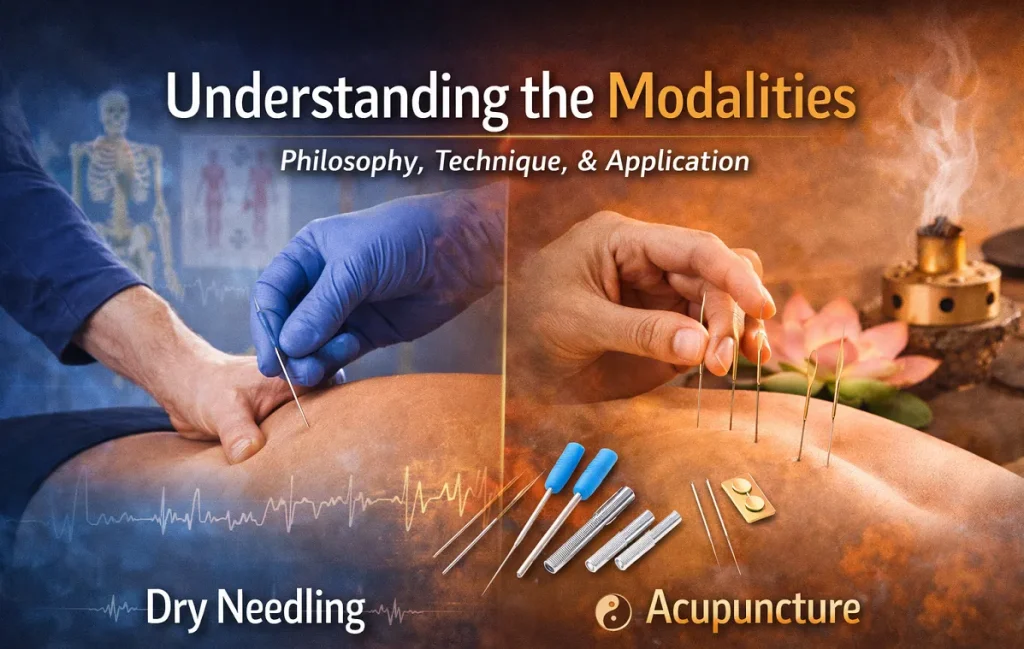
To properly stock a clinic or supply a medical network, one must understand how and why the practitioners use the tools. The dry needling vs acupuncture conversation is best understood by looking at the origin, the diagnostic process, and the clinical goals of each modality.
A. Traditional Acupuncture (TCM): Restoring Systemic Balance
Acupuncture is a key component of Traditional Chinese Medicine (TCM), a medical system with thousands of years of history.
- The Philosophy: TCM posits that the human body is animated by a vital life force called “Qi” (pronounced “chee”). This energy flows through a complex network of pathways called meridians. When Qi is blocked, deficient, or stagnant, illness and pain arise.
- The Technique: An acupuncturist diagnoses the patient by assessing the pulse, examining the tongue, and taking a holistic health history. They then insert needles into specific, historically mapped acupoints along the meridians to unblock the flow of Qi and restore systemic balance.
- Integrative Approaches: Acupuncture is rarely performed in a vacuum. It is often combined with other modalities to enhance the therapeutic effect. A classic example is herb & needle acupuncture, which includes techniques like moxibustion (burning the herb mugwort near or on the needle handle) to drive heat and restorative energy deep into the body.
B. Dry Needling: Western Neuromuscular Therapy
Dry needling, also known as intramuscular stimulation (IMS) or trigger point dry needling, is a relatively modern adaptation performed primarily by physical therapists, chiropractors, and sports medicine physicians.
- The Philosophy: Dry needling completely discards the concepts of Qi and meridians. Instead, it is firmly rooted in modern Western neuroanatomy, physiology, and biomechanics.
- The Technique: The practitioner palpates the patient’s muscles to find myofascial trigger points—hyper-irritable, taut bands of skeletal muscle (commonly known as “knots”). Needles are inserted directly into these trigger points to elicit a “local twitch response” (LTR). This spinal cord reflex essentially resets the muscle, releasing the tension, improving local blood flow, and alleviating the associated pain and dysfunction.
C. Clinical Comparison: The Approach to Back Pain
To truly understand the difference, let us look at a specific clinical scenario: dry needling vs acupuncture for back pain.
- The Dry Needling Approach: If a patient presents with lower back pain, a physical therapist will assess the musculature. They may find active trigger points in the quadratus lumborum, the erector spinae, or the gluteal muscles. They will select a needle—often a thicker, longer needle—and insert it directly into the taut muscle bands in the lower back and buttocks, physically manipulating the needle until the muscle twitches and releases.
- The Acupuncture Approach: A TCM practitioner treating the same back pain will take a different route. They may diagnose the pain as “Kidney Qi Deficiency” or “Blood Stagnation.” While they may place a few needles locally in the back, they will also place needles distally (far from the pain). They might place needles behind the knees (Bladder 40), around the ankles (Kidney 3), or even on the hands, aiming to clear the energetic pathways that traverse the back.
Table 1: Dry Needling vs. Acupuncture – A Clinical Summary
| الميزة | Traditional Acupuncture | Dry Needling |
| Origin | Ancient Eastern Medicine (TCM) | Modern Western Medicine |
| Primary Philosophy | Balancing Qi (Energy) along Meridians | Releasing Myofascial Trigger Points |
| Diagnostic Method | Tongue, pulse, holistic symptom evaluation | Palpation of muscles, orthopedic assessment |
| Needle Placement | Specific meridian acupoints (local and distal) | Directly into taut muscle bands (local) |
| Treatment Goal | Systemic health, organ function, pain relief | Systemic health, organ function, and pain relief |
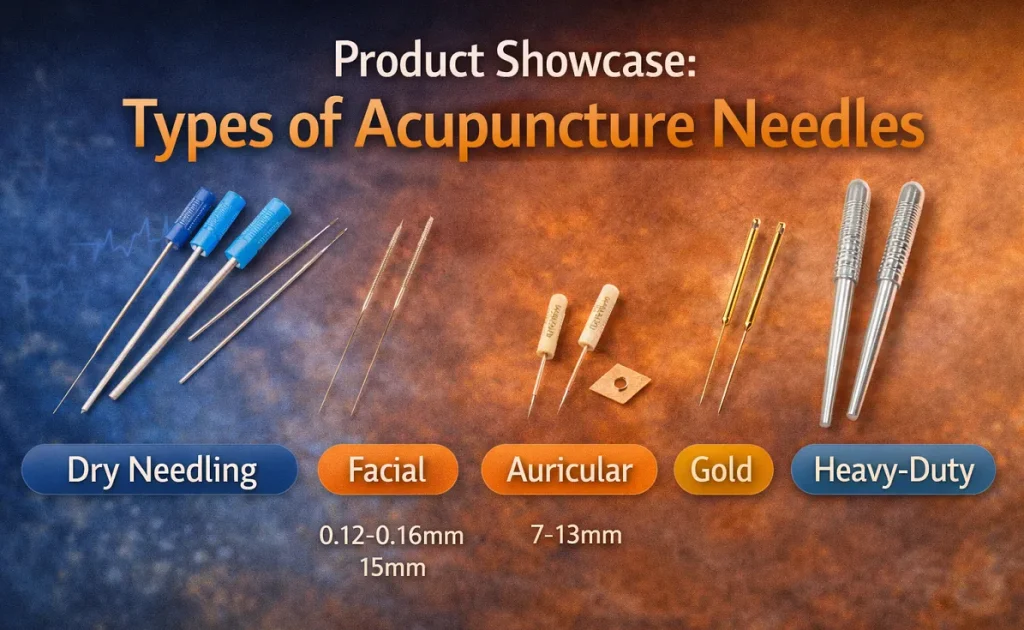
III. Product Showcase: Types of Acupuncture Needles
Because the techniques vary so wildly, a “one-size-fits-all” approach to manufacturing is impossible. As a primary manufacturer, we engineer specific types of acupuncture needles to meet the exact mechanical and anatomical demands of the practitioner.
A. Sizing and Dimensions: The Critical Metrics
The efficacy of a treatment relies heavily on the acupuncture needles size. Needles are measured by two metrics: Gauge (diameter/thickness) and Length.
- The Gauge: Thinner needles (e.g., 0.16mm to 0.20mm) cause less pain upon insertion but lack the rigidity required for deep tissue penetration. Thicker needles (e.g., 0.30mm to 0.35mm) are sturdier and elicit a stronger physiological response but can cause more patient discomfort.
- The Length: Length is dictated by the depth of the target tissue. Needles range from tiny 7mm tacks to massive 125mm needles.
Physical therapists performing dry needling on large muscles (like the gluteus maximus or the piriformis) require specialized long acupuncture needles (typically 75mm to 100mm in length, with a sturdy 0.30mm gauge). These needles are engineered with high-tensile surgical steel to ensure they do not bend or deflect when passing through dense fascial layers.
B. Specialized Anatomical Needles
Certain microsystems in the body require highly specialized manufacturing.
- Cosmetic and Facial Needles: Facial rejuvenation is a rapidly growing sector in TCM. Because the skin on the face is delicate and highly vascularized, practitioners require ultra-fine facial acupuncture needles. These are typically incredibly thin (0.12mm to 0.16mm) and short (15mm). Our manufacturing process utilizes a specialized silicone micro-coating and a unique automated grinding process to ensure these needles slide into the dermis seamlessly, preventing bruising and minimizing pain.
- Auricular (Ear) Needles: The ear is considered a microsystem that maps the entire body. Ear acupuncture needles (also widely searched as auricular acupuncture needles) are used extensively for addiction treatment (the NADA protocol), PTSD, and weight loss. These include tiny 7mm to 13mm filiform needles with plastic handles for high visibility, as well as “press tacks”—tiny needles mounted on surgical tape that the patient wears home for continuous stimulation.
C. Traditional and Premium Variations
While standard stainless steel needles are the norm, certain traditional practices require specialized materials.
- Gold-Plated Needles: For patients with severe nickel or stainless steel allergies, we manufacture acupuncture needles with gold variants. In TCM theory, gold is also believed to have a “tonifying” or warming effect on the body’s energy, making it a premium choice for specific therapeutic protocols.
- Legacy Equivalents: Many veteran practitioners were trained using specific legacy brands that define the “feel” of a traditional needle. We utilize advanced metallurgical techniques to produce high-quality equivalents to famous brands, offering the exact stiffness, traditional pine-needle tip geometry, and wire-wound handles associated with classic hwato acupuncture needles, but with modern, state-of-the-art sterilization.
- Heavy-Duty Needles: Certain ancient techniques involve heating the needle over a flame before insertion to treat joint pain and cysts. Standard needles will melt or lose their temper (stiffness) under extreme heat. We manufacture specialized, thicker-gauge needles made from specialized heat-resistant alloys specifically for the practice of fire needle acupuncture.
Table 2: Standard Needle Sizing and Clinical Application Guide
| القطر (مم) | Length (mm) | نوع المقبض | التطبيق السريري الأساسي | Modality |
| 0.12 – 0.16 | 13 – 15 | Plastic / Copper | Facial acupuncture needles, cosmetics, delicate skin | TCM / Aesthetics |
| 0.18 – 0.20 | 13 – 25 | Plastic | Ear acupuncture needles, shallow hand/foot points | TCM / Auricular |
| 0.25 – 0.30 | 25 – 40 | Spring / Tube | Standard body points (arms, legs, abdomen) | TCM / Dry Needling |
| 0.30 – 0.35 | 75 – 100+ | Spring / Tube | Long acupuncture needles for glutes, deep back | Dry Needling / Sports Med |
| 0.40+ | 25 – 50 | Thick Copper | Fire needle acupuncture, severe joint conditions | Facial acupuncture needles, cosmetics, and delicate skin |
IV. Sourcing and Supply Chain Solutions
For B2B buyers, securing a reliable supply chain is just as important as the clinical efficacy of the needles. The demand for إبر الوخز بالإبر التي تستخدم لمرة واحدة means clinics go through thousands of units a month.
A. Partnering with the Right Distributor
Hospitals, physical therapy networks, and large-scale TCM clinics rarely buy directly from the manufacturer in small quantities. They rely on established distribution hubs. By partnering with a comprehensive supplier—such as a golden needle acupuncture herbal & medical supply distributor—clinics can consolidate their purchasing. We work directly with these major distributors to provide OEM (Original Equipment Manufacturer) services, custom packaging, and bulk pricing.
B. The Non-Negotiable Standard: Sterility and Quality
In the era of modern medicine, patient safety is paramount.
- Single-Use Only: Every needle we manufacture is strictly single-use. The industry has entirely moved away from autoclaving reusable needles due to the high risk of cross-contamination and the degradation of the needle tip.
- Sterilization: Our facilities utilize medical-grade Ethylene Oxide (EtO) gas or Gamma Irradiation to ensure absolute sterility. Each batch is subjected to rigorous biological indicator testing before being released for global export.
- ISO Certification: We operate under strict آيزو 13485 quality management systems, ensuring that every needle—from the tiny auricular tack to the longest dry needle—meets the highest regulatory standards (CE, FDA).

V. Frequently Asked Questions (FAQs)
To assist both new practitioners and patients in understanding these therapies, we have compiled the most frequently asked questions regarding needle selection and clinical application.
Acupuncture needles act as micro-trauma stimuli. When inserted into the body, they trigger a cascade of physiological responses. They increase local blood flow, stimulate the central nervous system to release natural painkillers (like endorphins and enkephalins), relax tight muscle fibers, and modulate the body’s inflammatory response. In TCM terms, they unblock the flow of Qi and Blood to restore health.
No, they are distinct practices. While both modalities utilize the exact same physical instrument (a sterile, solid, stainless steel filiform needle), the training, diagnostic framework, and intended targets are different. Acupuncture is a holistic system aimed at balancing body energy, whereas dry needling is a western biomechanical technique used specifically to resolve muscle tension and pain.
The primary difference lies in the placement of the needles and the goal of the treatment. Dry needling vs acupuncture can be summarized by their targets: dry needling targets myofascial trigger points (knots) in the muscle to elicit a mechanical twitch response. Acupuncture targets specific, historically mapped points along energetic meridians to treat a wide variety of systemic conditions, organ dysfunctions, and pain.
The depth of needle insertion varies drastically based on the patient’s anatomy, body fat percentage, and the clinical objective. Needles placed on the scalp, face, or ears may only penetrate 1 to 2 millimeters. Conversely, when treating sciatica or performing deep tissue dry needling in the gluteal muscles, practitioners use long acupuncture needles that may be inserted 2 to 4 inches deep to reach the targeted muscle tissue.
Sciatica is typically caused by the compression of the sciatic nerve, often by a tight piriformis muscle in the buttocks. Practitioners will use long acupuncture needles inserted deeply into the gluteal region and lower back to release this tension. Additionally, a TCM practitioner will place needles along the Bladder and Gallbladder meridians, which run down the back of the leg, behind the knee, and down to the ankle.
For treating anxiety, the goal is to down-regulate the sympathetic nervous system (fight or flight) and promote deep relaxation. Needles are often placed at “Yintang” (the point between the eyebrows), “Shen Men” (on the inner wrist), and various points on the scalp. Additionally, auricular acupuncture needles are frequently placed in the ear’s specific Shen Men point, which is highly effective for calming the mind.
In TCM, erectile dysfunction is often viewed as a deficiency of Kidney Qi or poor local blood circulation. Treatment protocols typically involve placing needles in the lower abdomen (below the navel), the lower back (sacral region), and specific points along the inner legs and ankles, such as Spleen 6 and Kidney 3, to strengthen the body’s core energy and improve pelvic blood flow.
Unlike hollow hypodermic needles used for drawing blood or injecting medicine (which cut the tissue), إبر الوخز بالإبر التي تستخدم لمرة واحدة are solid, ultra-fine, and possess a smooth, rounded tip designed to part the tissue fibers rather than slice them. Most patients feel only a tiny prick or tap upon insertion, followed by a dull ache, a feeling of heaviness, or a slight tingling sensation, which is considered the therapeutic response. It is generally a very comfortable and relaxing experience.
If you are a clinical administrator or a medical distributor looking to upgrade your consumable supply chain, contact our enterprise sales team today. We provide comprehensive sample kits featuring everything from ultra-fine facial acupuncture needles to robust long acupuncture needles for physical therapy clinics, ensuring your practitioners have the exact tools they need for success.