I. Introduction: The Critical Role of Precision in Medical Consumables
In the medical field, the efficacy of a treatment is often defined not just by the medication itself, but by the delivery method. As a dedicated medical consumables manufacturer, we understand that a medical syringe with a needle is more than just a commodity; it is a precision instrument designed to ensure patient safety, accurate dosing, and clinical efficiency.
From standard immunizations to complex endoscopic procedures, the variety of injection systems available today is wide. Choosing the correct specification—whether for human or veterinary use—determines the comfort of the patient and the success of the procedure.
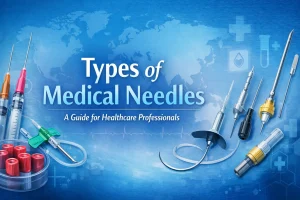
This guide provides an in-depth analysis of the “Types of Injection Needles,” categorizing them by clinical application, from general hypodermic needle injection to highly specialized surgical tools. We will explore the nuances of material science, gauge selection for viscous fluids like testosterone, and the latest innovations in safety types of injection needles.
II. Standard Clinical Injection Systems
The backbone of any hospital, clinic, or pharmacy inventory is the standard injection system. These tools handle the vast majority of therapeutic and diagnostic tasks.
A. The General Purpose Syringe Assembly
The standard medical injection syringe typically consists of three parts: the barrel, the plunger, and the piston. While historical models utilized glass, the modern industry standard is the plastic injection syringe. Made from high-grade medical polypropylene, these syringes offer chemical inertness, transparency for dosage verification, and cost-effectiveness.
Disposable vs. Reusable
The shift toward the disposable injection syringe has revolutionized infection control. Single-use systems eliminate the risk of cross-contamination—a critical factor in hospital environments. While brands like the bd injection syringe set early benchmarks for quality, our manufacturing processes now match these rigorous standards, offering high-clarity barrels and smooth plunger movement essential for precise dosing.
B. Intravenous (IV) Therapy
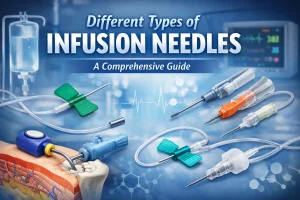
Distinct from intramuscular or subcutaneous tools, the IV injection needle (often referred to as a butterfly needle or cannula) is designed for accessing veins. These needles differ structurally:
- Angle of Entry: Designed for shallow insertion (15–30 degrees).
- Stability: Winged designs allow for secure taping to the skin for long-term infusion.
- Flashback: Transparent chambers allow the nurse to see blood return, confirming the needle is successfully in the vein.
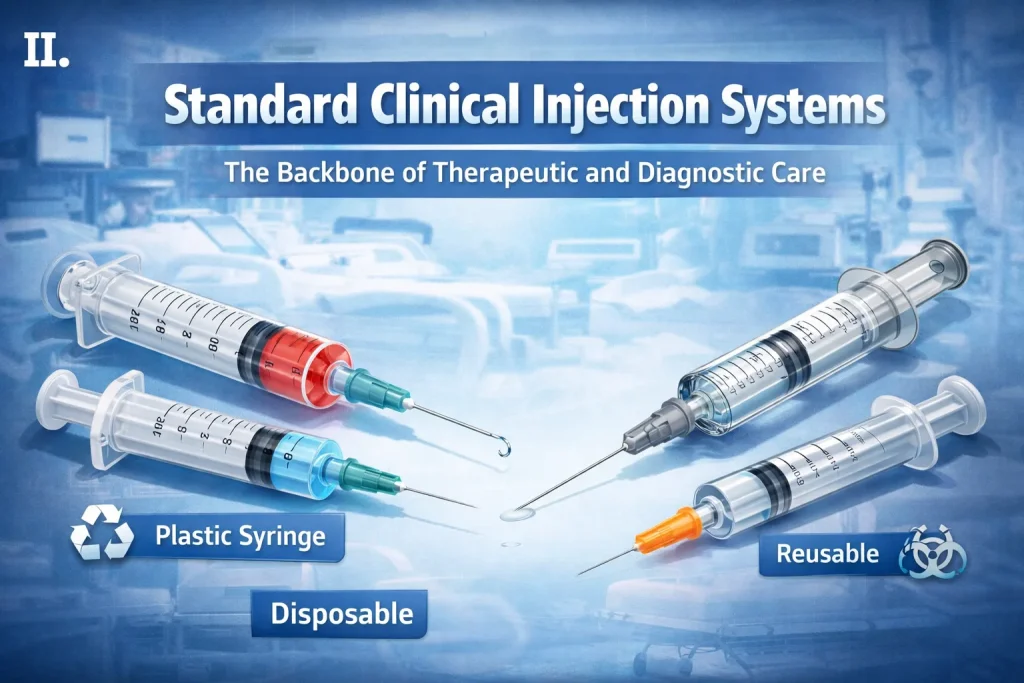
Table 1: Syringe Tip Designs and Applications
| Tip Type | Description | Primary Application |
| Luer Lock | Needle twists onto the tip and locks in place. | High-pressure injections; thick fluids; preventing needle detachment. |
| Luer Slip | Needle pushes onto the tip (friction grip). | Quick injections; diabetic management; low-pressure usage. |
| Catheter Tip | Long, tapered tip. | Flush wounds; enteral feeding (tube feeding); veterinary bladder wash. |
| Eccentric Tip | Tip is off-center (on the edge of the barrel). | The tip is off-center (on the edge of the barrel). |
III. Diabetes Management Solutions
Diabetes care represents one of the largest segments of the injection market. Patients require diabetic injection needles that are not only accurate but comfortable enough for multiple daily injections.
A. Insulin Needles and Syringes
The modern insulin injection needles are marvels of micro-engineering. They are typically characterized by:
- Ultra-fine Gauges: Ranging from 29G to 32G (and recently 34G), these thin needles minimize the trauma to nerve endings in the skin.
- Short Lengths: Usually 4mm to 8mm, designed to deliver insulin into the subcutaneous fat layer without piercing muscle.
However, clinical scenarios vary. While subcutaneous delivery is standard, there are rare instances where an insulin syringe for intramuscular injection is discussed, usually involving longer needles (12.7mm or more) for patients with higher BMI where standard short needles might not penetrate the adipose tissue effectively, or for specific hormonal protocols requiring deeper absorption.
B. Innovations in Delivery
For patients suffering from needle phobia, technology is moving toward needleless insulin injection. These devices, often jet injectors, use high-pressure air to force a fine stream of insulin through the skin. While insulin injection without needle systems reduces puncture wounds, they are often more expensive and complex than traditional syringes.
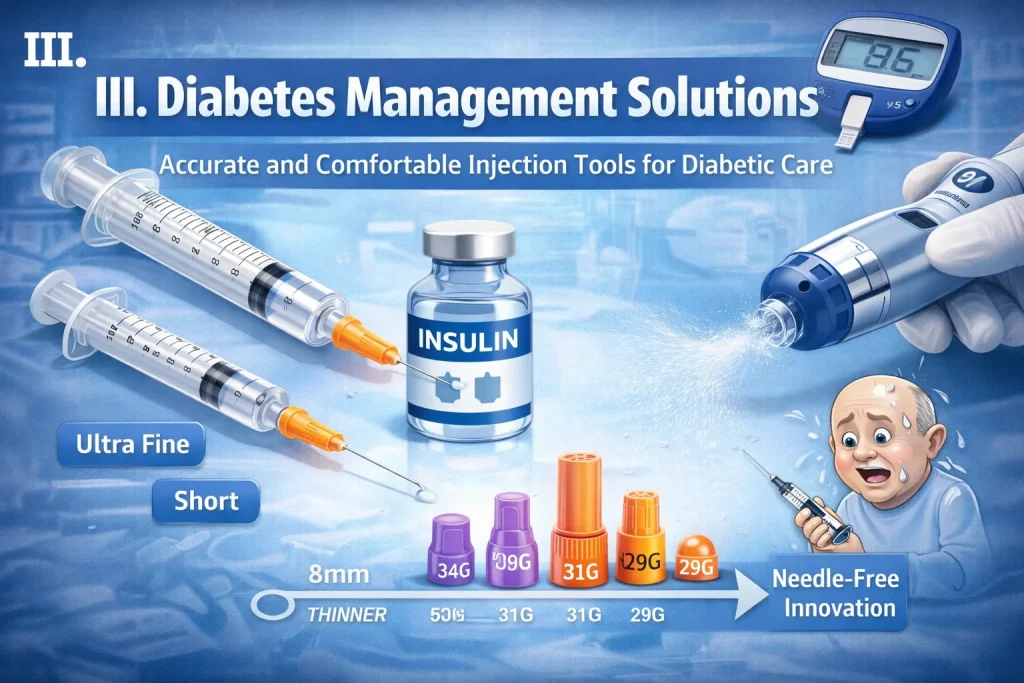
Table 2: Insulin Syringe Capacities (U-100 Standard)
| Syringe Size | Capacity (Units) | Recommended Dosage |
| 0.3 mL | 30 Units | For doses under 30 units. Offers widest spacing for easy reading. |
| 0.5 mL | 50 Units | For doses between 30 and 50 units. |
| 1.0 mL | 100 Units | For doses under 30 units. Offers the widest spacing for easy reading. |
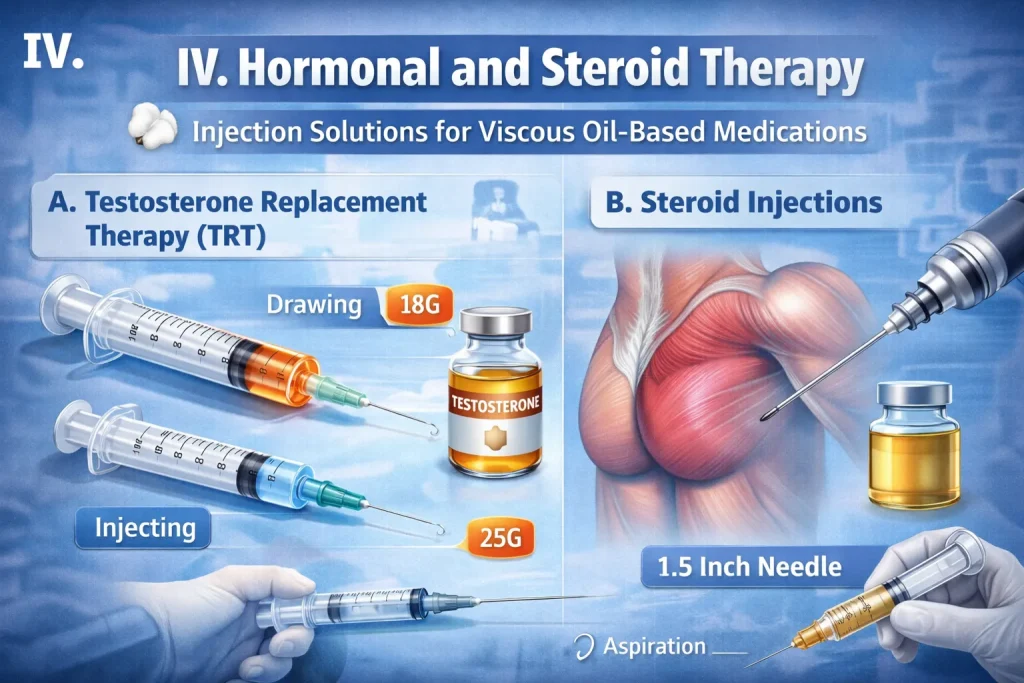
IV. Hormonal and Steroid Therapy
Unlike insulin, which is water-based (aqueous), many hormones are suspended in oil. This viscosity fundamentally changes the requirement for sterile types of injection needles.
A. Testosterone Replacement Therapy (TRT)
Administering testosterone requires a two-step consideration due to the thickness of the oil (often cottonseed or grapeseed oil).
- Drawing: A large gauge needle (18G–21G) is used to draw the oil into the syringe quickly.
- Injecting: The needle is swapped for testosterone injection needles, typically sized 23G or 25G. Using a needle that is too small (e.g., 30G) would make depressing the plunger nearly impossible, while a needle that is too large causes unnecessary pain.
B. Steroid Injection Needles
Similar to TRT, the steroid types of injection needles must be robust. For deep intramuscular injections (glutes or deltoids), needle length is critical. A standard 1.5-inch needle is often required to bypass subcutaneous fat and ensure the medication is deposited deep within the muscle belly to prevent abscesses.
Key Safety Note: Aspiration (pulling back on the plunger) is often taught in these procedures to ensure the needle has not entered a blood vessel.
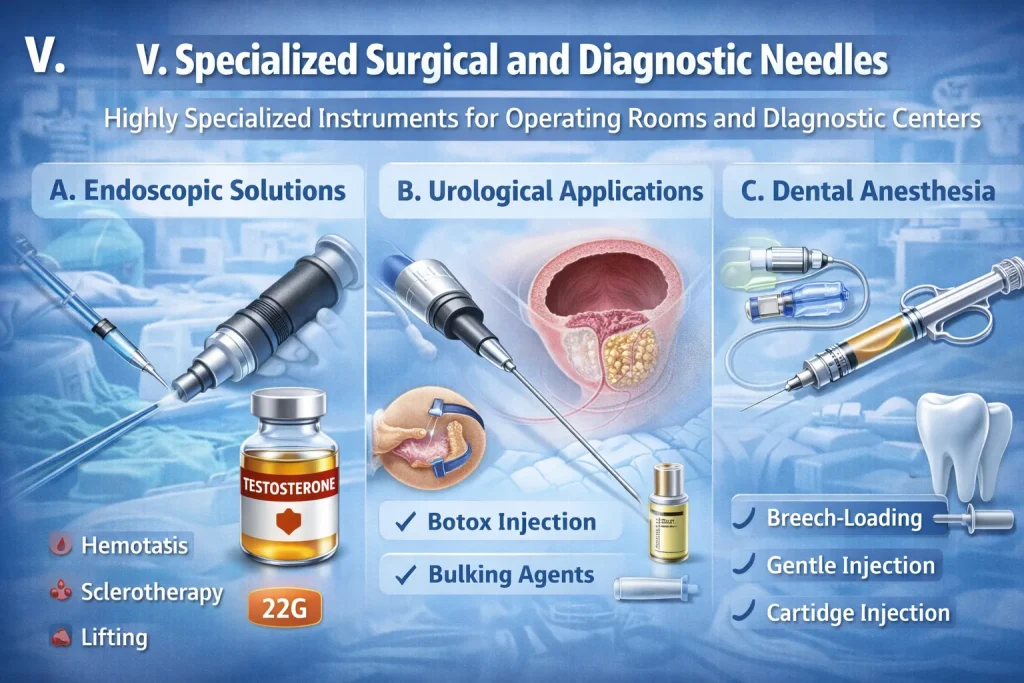
V. Specialized Surgical and Diagnostic Needles
Beyond general ward use, our manufacturing lines produce highly specialized instruments for operating rooms and diagnostic centers.
A. Endoscopic Solutions
Le endoscopic injection needle is a vital tool in gastroenterology. Passed through the working channel of an endoscope, these long, flexible catheters tipped with a needle are used for:
- Hemostasis: Injecting epinephrine to stop bleeding ulcers.
- Sclerotherapy: Treating esophageal varices.
- Lifting: Injecting saline to lift polyps away from the muscle wall before resection (EMR).
B. Urological Applications
Le cystoscopic injection needle operates on a similar principle but is designed for the bladder. Urologists use these for injecting Botulinum toxin (Botox) into the bladder wall to treat an overactive bladder or for injecting bulking agents to treat urinary incontinence. These needles must offer exceptional flexibility to navigate the cystoscope angles without kinking.
C. Dental Anesthesia
Le dental injection syringe is distinct from standard medical syringes. It is typically a reusable metal or durable plastic breech-loading syringe that accepts a pre-filled anesthetic cartridge (carpule) and a double-ended needle. These allow for high-pressure injection into the dense gum tissue (gingiva) and periodontal ligaments.
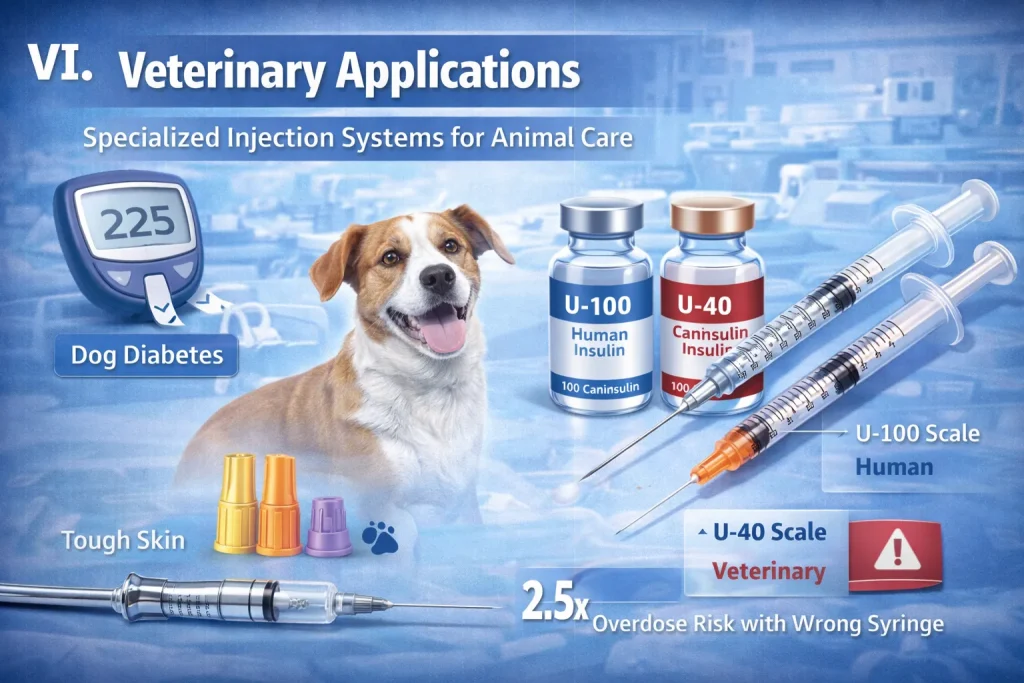
VI. Veterinary Applications
The physiology of animals dictates different requirements for injection hardware.
Canine Diabetes
A critical distinction in veterinary medicine is the concentration of insulin. While human insulin is typically U-100 (100 units per mL), veterinary insulin (like Caninsulin) is often U-40 (40 units per mL). Insulin syringes for dogs must be calibrated to the U-40 scale. Using a human U-100 syringe for a dog prescribed U-40 insulin without conversion will result in a potentially fatal overdose (2.5x the intended dose).
Additionally, the skin thickness of animals often requires sturdier needles than standard human diabetic types of injection needles to prevent bending during administration through fur and tougher hides.
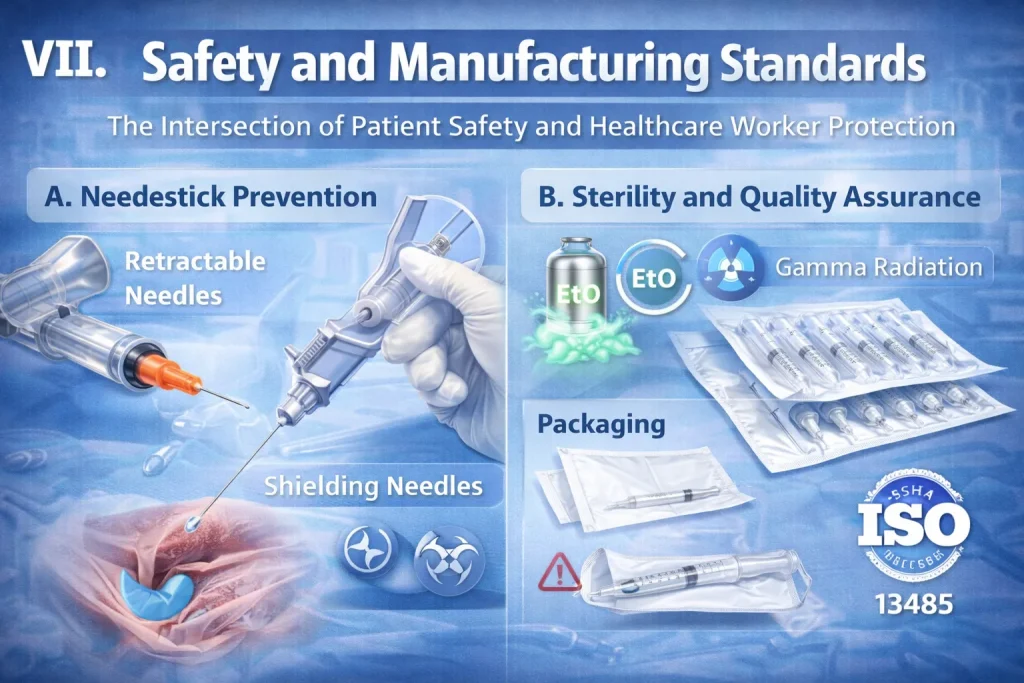
VII. Safety and Manufacturing Standards
As a manufacturer, our top priority is the intersection of patient safety and healthcare worker protection.
A. Needlestick Prevention
Needlestick injuries remain a significant risk in healthcare. We produce safe types of injection needles equipped with engineered safety mechanisms.
- Retractable Needles: The needle is pulled back into the barrel automatically after the plunger is fully depressed.
- Shielding Needles: A hinged plastic shield is flipped over the needle immediately after withdrawal. These mechanisms are essential for complying with OSHA requirements and reducing the transmission of bloodborne pathogens.
B. Sterility and Quality Assurance
All our products, from the basic medical syringe with needle to complex surgical tools, undergo rigorous sterilization.
- Sterilization Method: Most sterile types of injection needles are sterilized using Ethylene Oxide (EtO) gas or Gamma Irradiation.
- Emballage : Blister packs or peel-pouches maintain sterility until the moment of use. A compromised package renders the needle non-sterile.
- Regulatory Compliance: Our facilities adhere to ISO 13485 standards, ensuring that every batch of plastic injection syringe products meets global safety benchmarks.
VIII. Conclusion
The landscape of medical injections is diverse. Whether it is the daily routine of a diabetic patient using insulin injection needles, a nurse administering a vaccine with a disposable injection syringe, or a surgeon utilizing an endoscopic injection needle, the quality of the device is paramount.
We are committed to supplying high-precision, safety-compliant, and versatile injection solutions. By understanding the specific requirements of testosterone injection needles, veterinary needs, and advanced safety mechanisms, procurement officers and clinicians can ensure better outcomes and safer environments.
Next Steps: If you are looking for a reliable partner for high-volume, compliant medical consumables, please contact our sales team to request a catalog or samples of our sterile injection needles and syringe assemblies.
Frequently Asked Questions (FAQs)
A Luer Lock syringe has threads that allow the needle to be twisted and locked securely into place, preventing it from popping off under high pressure (common with thick oils). A Luer Slip relies on friction; the needle is simply pushed on. Luer Slips are often used for quick, low-pressure injections like vaccines.
For thick, oil-based medications like testosterone, a medical syringe with a needle combination is often split into two steps. Use a large gauge (18G-21G) to draw the fluid into the barrel, and swap to a smaller gauge (23G-25G) testosterone injection needle for the actual injection. This balances flow rate with patient comfort.
Yes, often they are. Veterinary insulin is frequently U-40 (40 units/mL), whereas human insulin is U-100 (100 units/mL). Insulin syringes for dogs must match the insulin concentration. Using a human U-100 syringe with U-40 insulin requires complex math and poses a high risk of dosing errors.
Needleless insulin injection or insulin injection without needle systems use high pressure to force insulin through the skin. The primary benefits are the elimination of needle phobia, reduction of puncture wounds, and prevention of accidental needlestick injuries for caregivers.
“Dead space” is the volume of fluid left in the hub of the syringe and needle after the plunger is fully depressed. In diabetic injection needles and pediatric dosing, high dead space can lead to medication waste or dosage inaccuracies. Low dead-space syringes are engineered to minimize this leftover fluid.
No. A disposable injection syringe is designed for single use only. The plastic degrades, the lubricant on the plunger wears off, and home sterilization methods (like boiling) cannot effectively clean the microscopic lumen of the needle, leading to high risks of infection and tissue damage from a dull needle.
Manufacturers typically use Ethylene Oxide (EtO) gas or Gamma Irradiation to produce sterile injection needles. These methods penetrate the packaging to kill all microorganisms without damaging the materials. The sterility is guaranteed only as long as the packaging remains unopened and undamaged.
A standard hypodermic needle injection is used to deposit medication into tissue (muscle or fat). An iv injection needle (often a butterfly or cannula) is specifically designed to enter a vein and stay there for fluid delivery. IV needles often have flexible wings for stability and a design that minimizes damage to the vein wall.