








As a medical consumable manufacturer, understanding the nuanced engineering behind needles in phlebotomy is critical to producing devices that ensure patient safety, clinical efficacy, and laboratory accuracy. The simple act of drawing blood is the foundational step in over 70% of all medical diagnoses. Therefore, the tools utilized to access the venous system must be manufactured to exacting tolerances, balancing razor-sharp precision with advanced safety mechanics.
This comprehensive guide delves into the mechanical design, clinical applications, and global sourcing requirements for the various types of needles used in phlebotomy. By examining structural differences, gauge classifications, and supply chain dynamics, this document serves as an authoritative resource for procurement officers, medical distributors, and healthcare professionals navigating the complex landscape of vascular access consumables.
1. Introduction to Venipuncture Equipment
The modern clinical environment relies heavily on a highly standardized, closed-loop diagnostic collection system. At the forefront of this system are the needles used in phlebotomy, which serve as the vital conduit between the patient’s circulatory system and the laboratory environment.
The Closed-Loop System
Historically, blood collection was an open procedure fraught with the risks of exposure and sample contamination. Today, state-of-the-art phlebotomy needles and tubes operate in tandem through a closed vacuum system. The needle penetrates the vein, and a specialized secondary needle (or the back-end of a two-way needle) punctures the rubber septum of a diagnostic tube. The pre-measured vacuum inside the tube automatically draws the exact volume of blood required for specific chemical, hematological, or coagulation testing. Manufacturers must ensure that the siliconized cannula, the plastic hub, and the synthetic rubber sleeves are engineered to interface flawlessly, maintaining a hermetic seal under varying atmospheric pressures.
Occupational Safety and Regulatory Mandates
Needlestick injuries remain one of the most severe occupational hazards for healthcare workers, presenting risks of transmitting bloodborne pathogens such as HIV, Hepatitis B, and Hepatitis C. Consequently, global regulatory bodies like the U.S. Occupational Safety and Health Administration (إدارة السلامة والصحة المهنية) and the European Medicines Agency (EMA) have instituted strict directives mandating the use of safety-engineered devices.
Modern needles in phlebotomy are now required to incorporate integrated safety mechanisms. These include hinged plastic shields that lock over the contaminated cannula immediately after withdrawal, or push-button retraction systems that instantly pull the needle safely into a sterile plastic housing while still in the vein. For a medical manufacturer, integrating these safety mechanisms without compromising the structural integrity or the ergonomic handling of the needle is a primary engineering challenge.
2. Primary Types of Needles Used in Phlebotomy
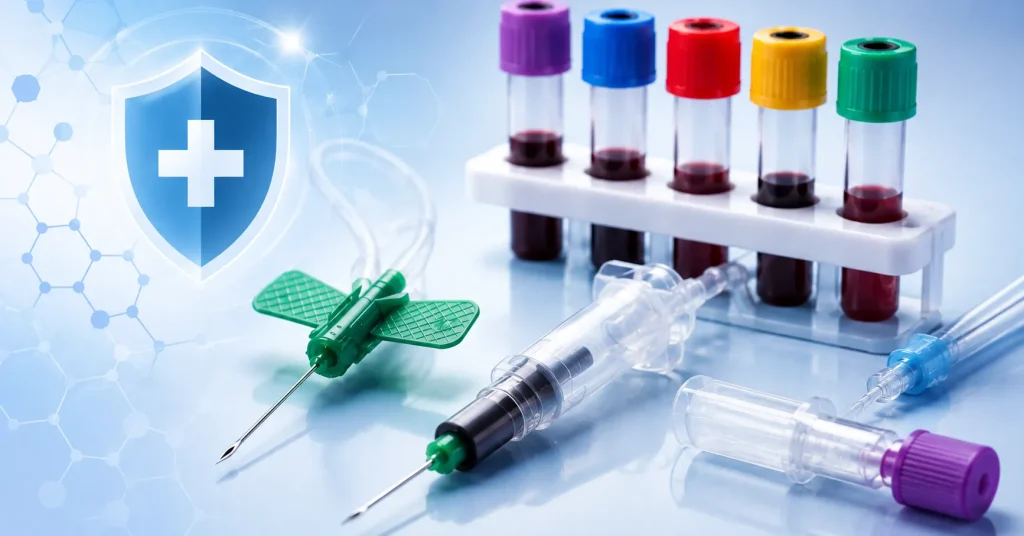
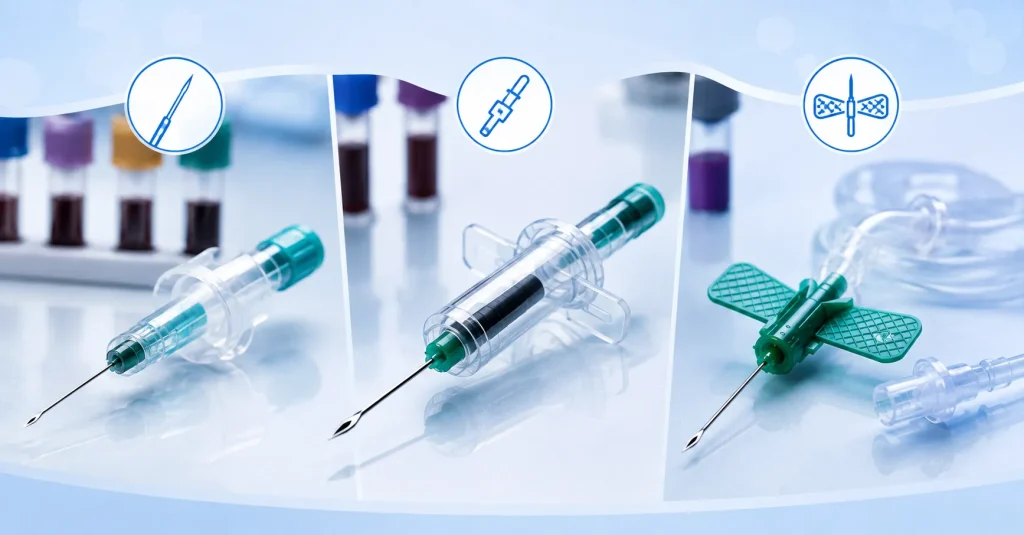
Patient demographics, vein conditions, and specific diagnostic requirements dictate that a one-size-fits-all approach is impossible in venipuncture. Clinicians rely on three primary configurations, each presenting unique manufacturing requirements and clinical advantages.
Straight Needle Phlebotomy
The cornerstone of routine diagnostic blood draws is straight needle phlebotomy. This design consists of a rigid, stainless steel cannula securely bonded to a threaded plastic hub.
- Clinical Application: Straight needles are the workhorse of high-throughput clinics. They are primarily used on healthy adult patients with prominent, easily accessible median cubital veins. The rigidity of the needle allows the phlebotomist to anchor it securely, facilitating the rapid filling of multiple vacuum tubes.
- Manufacturing Perspective: The production of straight needles requires high-tensile medical-grade stainless steel (typically SUS304 or SUS316L) to prevent bending. The hubs are injection-molded using medical-grade polypropylene and are typically color-coded to international gauge standards. The threading on the hub must be universally compatible with standard needle holders to ensure a secure, leak-free fit.
Two-Way Needle Phlebotomy
Directly associated with the evacuated tube system is the two-way needle phlebotomy design, also widely known as a multi-sample needle.
- Mechanical Design: This needle features a single, continuous metal cannula that is pointed on both ends. One end enters the patient’s vein, while the other end (the shorter side) sits inside the plastic holder and is covered by a specialized, retractable synthetic rubber sleeve.
- Functional Advantage: When a vacuum tube is pushed into the holder, it compresses the rubber sleeve, allowing the internal needle to pierce the tube’s septum and initiate blood flow. The moment the tube is removed, the rubber sleeve instantly springs back to its original position, covering the needle point and halting the flow of blood. This brilliant mechanical valve prevents blood from dripping into the holder or onto the clinician while they are swapping multiple diagnostic tubes.
Butterfly Phlebotomy Draw (Winged Infusion Sets)
When accessing the venous system of pediatric patients, geriatric patients, or adults with highly fragile, rolling, or superficial veins, clinicians pivot to a butterfly phlebotomy draw.
- Ergonomic Superiority: Also known as a phlebotomy butterfly draw, this device features a short straight needle flanked by two flexible plastic wings, connected to a length of transparent, flexible tubing. The wings allow the clinician to grip the needle close to the skin, facilitating an ultra-shallow insertion angle (often 10 to 15 degrees).
- Shock Absorption: Once inserted, the wings are taped flat against the skin. If the patient moves, or if the phlebotomist manipulates the vacuum tubes at the end of the line, the flexible tubing acts as a shock absorber. This prevents the mechanical force from transferring to the needle tip inside the vein, drastically reducing tissue trauma and preventing the vein from blowing.
- Manufacturing Nuances: Producing butterfly needles is highly complex. It requires precision ultrasonic welding to attach the soft thermoplastic elastomer (TPE) wings to the needle hub, and secure adhesive bonding to attach the flexible PVC or polyurethane tubing without restricting the internal flow path.
3. Phlebotomy Needle Gauge Chart & Sizing Guidelines
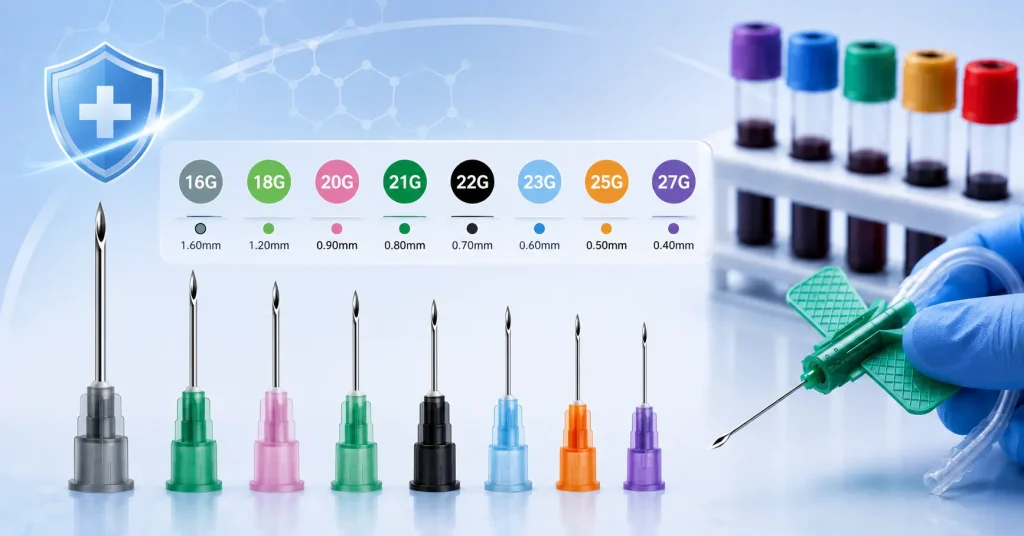
Understanding needle sizing is critical to maintaining sample integrity. The gauge of a needle refers to its outer diameter. It is essential to note that the gauge system operates inversely: the higher the gauge number, the thinner the needle.
Standardizing Sizes: The Phlebotomy Needle Gauge Chart
To prevent errors in high-stress medical environments, manufacturers adhere strictly to universal color-coding standards for needle hubs. Below is a comprehensive Phlebotomy needle gauge chart detailing the physical dimensions and primary clinical applications for different sizes.
| حجم المقياس | اللون القياسي للمحور | القطر الخارجي (مم) | Clinical Flow Rate | Primary Phlebotomy Application |
| 16G | أبيض | 1.60 مم | فائق السرعة | Therapeutic phlebotomy, large-volume blood donation. |
| 18G | وردي | 1.20 مم | سريع جدًا | Blood bank collection, rapid fluid replacement, trauma. |
| 20G | أصفر | 0.90 مم | سريع | Multi-tube large-volume diagnostic draws in adults. |
| 21G | أخضر | 0.80 مم | قياسي | The universal standard for routine adult diagnostic venipuncture. |
| 22G | أسود | 0.70 مم | معتدل | Older children and adults with slightly smaller veins. |
| 23G | أزرق فاتح | 0.60 مم | بطيء | Butterfly sets for pediatrics, geriatrics, and hand veins. |
| 25G | برتقالي | 0.50 مم | بطيء جدًا | Neonatal care and highly specialized micro-draws. |
Selecting the Common Needle Gauge for Venipuncture
عند تحديد common needle gauge for venipuncture, the 21G and 22G needles dominate the clinical landscape.
The 21G (green hub) is the most common needle gauge for phlebotomy. It offers the perfect equilibrium between patient comfort and flow dynamics. The internal lumen is wide enough to allow blood to flow rapidly without subjecting the red blood cells to excessive shear stress. If a healthy adult requires blood work, a 21G straight needle is the primary instrument of choice.
The 22G (black hub) is the secondary common gauge needle for phlebotomy, frequently utilized for patients whose veins are slightly too narrow or fragile for a 21G, but who do not yet require the specialized intervention of a butterfly needle.
Hemolysis and Needle Gauge Sizes for Phlebotomy
Clinicians must carefully evaluate needle gauge sizes for phlebotomy to prevent hemolysis—the rupturing of red blood cells. When blood is forced through an incredibly narrow opening (such as a 25G needle) under the strong negative pressure of a vacuum tube, the physical shear forces tear the cellular membranes apart. Hemolyzed samples release intracellular potassium and enzymes into the serum, rendering the sample medically useless and forcing a redraw. Advanced manufacturing combats this via “thin-wall” technology, creating needles that retain a small outer diameter (for patient comfort) while maximizing the internal lumen diameter (for improved flow and reduced cell shearing).
Therapeutic Phlebotomy Needle Size
While diagnostic testing requires small volumes of blood, certain medical conditions—such as hemochromatosis (iron overload) or polycythemia vera (excess red blood cells)—require the rapid removal of up to 500 milliliters of whole blood.
In these scenarios, standard diagnostic gauges are entirely insufficient. The standard therapeutic phlebotomy needle size ranges from 16G to 18G. A 16G needle possesses a massive 1.60mm outer diameter. This heavy-duty conduit allows for the rapid, continuous drainage of thick, highly viscous whole blood without clotting within the cannula. Manufacturing these large-gauge needles requires robust bevel grinding to ensure that, despite the large diameter, the tip remains razor-sharp to minimize the significant tissue trauma associated with large-bore venipuncture.
4. Commercial Sourcing and Global Supply Chain
The global demand for vascular access consumables is staggering. Hospitals, outpatient laboratories, and independent clinics consume billions of units annually. For procurement officers and medical distributors, navigating the supply chain to secure high-quality types of needles used in phlebotomy requires strict vendor qualification.
Differentiating Clinical Demands
Purchasing behaviors differ vastly depending on the clinical setting:
- High-Volume Hospital Laboratories: These institutions primarily source 21G and 22G straight, two-way needle phlebotomy systems in massive bulk. Their primary focus is on cost-efficiency, seamless integration with automated tube assembly lines, and reliable passive safety mechanisms to protect their large staff pools.
- Pediatric and Oncology Centers: These specialized facilities allocate a significantly higher percentage of their budgets to 23G and 25G winged infusion sets. They prioritize ultra-thin wall technology, premium silicone coatings for painless insertion, and highly flexible tubing to accommodate moving or highly distressed patients.
Procuring Phlebotomy Needles for Sale
When B2B buyers search for phlebotomy needles for sale, they must evaluate manufacturers beyond simple unit pricing. A defective batch of needles can lead to facility-wide halts in diagnostic testing and severe regulatory penalties. Buyers should evaluate manufacturers based on the following metrics:
- Material Traceability: Manufacturers must provide documentation proving the use of certified medical-grade stainless steel (SUS304/SUS316L) to guarantee biocompatibility and structural rigidity.
- Precision Beveling: The quality of the needle tip dictates the patient experience. Procurement teams should look for manufacturers utilizing automated, multi-stage robotic grinding to produce triple-bevel, laser-sharp points.
- Siliconization Processes: The best needles are micro-coated with proprietary medical silicone. This reduces the drag coefficient as the needle enters the skin. Buyers should request samples to test penetration forces physically.
Securing Reliable Phlebotomy Needle Supplies
To establish a resilient pipeline of phlebotomy needle supplies, distributors must partner with manufacturers that hold unquestionable regulatory certifications. Essential credentials include ISO 13485 (Quality Management for Medical Devices), CE marking for European markets, and FDA 510(k) clearance for the United States.
Furthermore, a top-tier manufacturer will have heavily invested in Automated Optical Inspection (AOI) within their cleanrooms. These high-speed camera systems scan every single needle on the production line, automatically ejecting units with microscopic burrs, blunt tips, or misaligned hubs. Finally, stringent sterilization protocols—typically utilizing Ethylene Oxide (إيتو) gas or Gamma Irradiation—must be fully validated to ensure that every single needle arrives at the clinical frontline completely sterile, non-pyrogenic, and ready to safely facilitate life-saving diagnostics.

الأسئلة الشائعة (FAQs)
The three primary configurations are straight needles (used for standard, high-throughput adult draws), multi-sample two-way needles (designed for filling multiple vacuum tubes sequentially without leakage), and winged infusion sets or butterfly needles (used for delicate, superficial, or difficult veins).
A butterfly phlebotomy draw is ideal when dealing with patients who have small, fragile, or rolling veins, such as infants, the elderly, or oncology patients. The plastic wings allow for a very shallow insertion angle, and the flexible tubing acts as a shock absorber if the patient moves during the procedure.
Because therapeutic procedures require the rapid removal of large volumes of whole blood (often up to 500mL for conditions like hemochromatosis), a much larger needle is required. The standard therapeutic phlebotomy needle size is typically 16G or 17G, which prevents the thick blood from clotting during the lengthy drainage process.
A two-way needle phlebotomy system uses a needle pointed on both ends. The inner part of the needle, housed within the plastic holder, is covered by a synthetic rubber sleeve. When a vacuum tube is pressed onto the needle, the sleeve pushes back to let blood flow. When the tube is removed, the rubber sleeve instantly springs back, acting as a valve to stop blood from dripping.
The 21G needle, universally identified by its green plastic hub, is the most common gauge needle for phlebotomy. It provides the optimal balance, offering a wide enough internal lumen to draw blood quickly without damaging the red blood cells, while maintaining an outer diameter small enough to ensure minimal patient discomfort.
Sourcing phlebotomy needle supplies from ISO 13485-certified manufacturers guarantees that the products are made in highly controlled cleanroom environments, utilizing medical-grade materials, precise automated grinding, and validated sterilization processes, thereby ensuring absolute safety and regulatory compliance.
Modern phlebotomy needles and tubes operate as a closed vacuum system. The needle accesses the vein, and the back end pierces the rubber stopper of a sealed tube. The precise vacuum inside the tube automatically pulls the correct volume of blood directly from the vein, preventing any environmental exposure or aerosolization of the blood.
Distributors should source phlebotomy needles for sale directly from established medical consumable manufacturers who specialize in injection molding, cannula grinding, and automated assembly. Buyers must ensure the vendor provides full CE/FDA certifications, raw material traceability, and guaranteed Ethylene Oxide (EtO) sterilization records.