







I. Introdução: Engenharia da injeção moderna
Na cadeia global de fornecimento de consumíveis médicos, a distinção entre instrumentos de precisão e ferramentas padrão dita os resultados clínicos. Uma questão frequente e fundamental na engenharia e aquisição biomédicas é a agulha hipodérmica vs agulha normal comparação. Enquanto uma “agulha normal” - tal como uma agulha de sutura cirúrgica ou uma agulha têxtil tradicional - é uma peça sólida de aço estirado, concebida estritamente para perfurar e passar o fio através de um substrato, uma agulha hipodérmica é um feito de engenharia completamente diferente. A palavra “hipodérmica” tem origem grega e significa “sob a pele”. Portanto, agulhas hipodérmicas médicas são tubos ocos altamente especializados (cânulas) concebidos para administrar fluidos, medicamentos e vacinas diretamente nos tecidos ou no sistema vascular do corpo, ou para extrair fluidos como o sangue para testes de diagnóstico vitais.
Como principal fabricante de agulhas para especialidades médicas e de equipamento de inspeção automatizado de última geração para linhas de produção médica, as nossas instalações compreendem que o fabrico de uma cânula oca requer uma precisão exponencialmente maior do que uma agulha sólida. A integridade estrutural da parede ultrafina de aço inoxidável, a geometria microscópica da ponta biselada e a dinâmica dos fluidos do lúmen interno são críticas. Uma rebarba microscópica ou um bisel desalinhado pode causar um traumatismo grave no doente, a perfuração de tecidos ou a perda de medicação.
Por conseguinte, o nosso papel entre os fabricantes de agulhas hipodérmicas vai muito além da metalurgia básica. Fornecemos uma carteira abrangente de instrumentos de injeção concebidos com tolerâncias de zero defeitos. Atendemos estritamente a redes de aquisição B2B, sistemas hospitalares e distribuidores clínicos, assegurando que os nossos parceiros da cadeia de fornecimento recebem instrumentos que funcionam sem falhas sob elevada pressão clínica. Este guia serve como um portfólio técnico definitivo, detalhando as nossas capacidades de fabrico, as especificações precisas de vários calibres e o nosso compromisso inabalável com o controlo de qualidade automatizado.
II. Anatomia e padrões de ligação
Para avaliar eficazmente as nossas linhas de produtos, os responsáveis pelas aquisições e os diretores clínicos têm de compreender a anatomia estrutural das nossas agulhas. Não nos limitamos a montar peças; concebemos cada elemento microscópico da agulha para otimizar a taxa de fluxo e minimizar o desconforto do doente.
A. A física do bisel e do lúmen
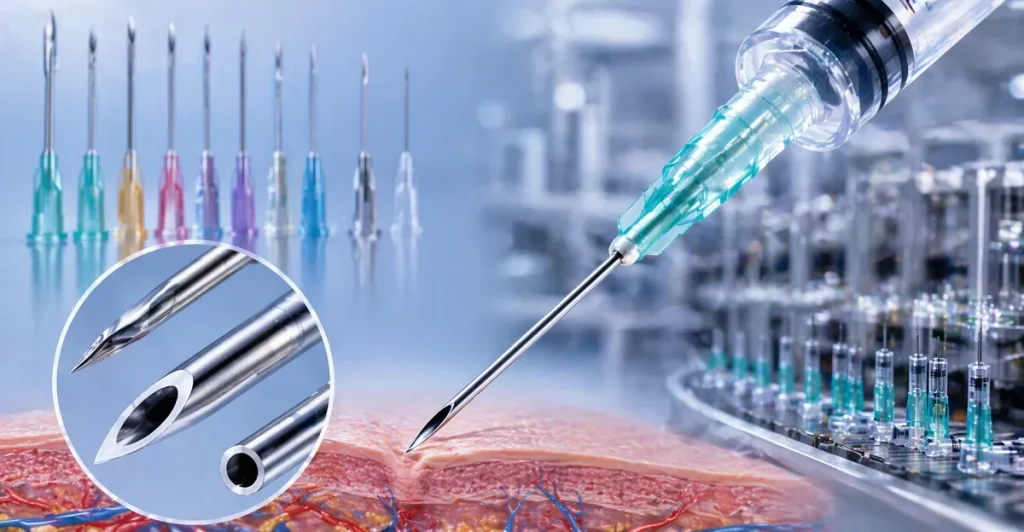
O desempenho de qualquer agulha hipodérmica depende em grande medida de dois elementos: o bisel (a ponta inclinada) e o lúmen (o interior oco).
- O bisel: Utilizamos maquinaria avançada e automatizada de retificação multi-ângulo para criar biséis intradérmicos padrão, curtos e verdadeiros. O ângulo primário corta o caminho inicial, enquanto os ângulos secundários separam o tecido suavemente em vez de o rasgarem. Esta abordagem multi-nivelada requer uma inspeção ótica automatizada constante para garantir uma nitidez absoluta.
- O Lumen: O diâmetro interno determina a dinâmica do fluido. Através de técnicas patenteadas de extrusão de paredes finas e ultra-finas, maximizamos o tamanho do lúmen sem comprometer o diâmetro exterior da cânula, permitindo taxas de fluxo mais rápidas de medicamentos altamente viscosos (como a testosterona ou produtos biológicos concentrados), mesmo através de agulhas de menor calibre.
B. Concepções e ligações dos cubos
Uma agulha é tão segura quanto a sua ligação à seringa. O encaixe, normalmente fabricado em polipropileno de qualidade médica, tem de bloquear sem problemas para evitar o rebentamento em injecções de alta pressão.
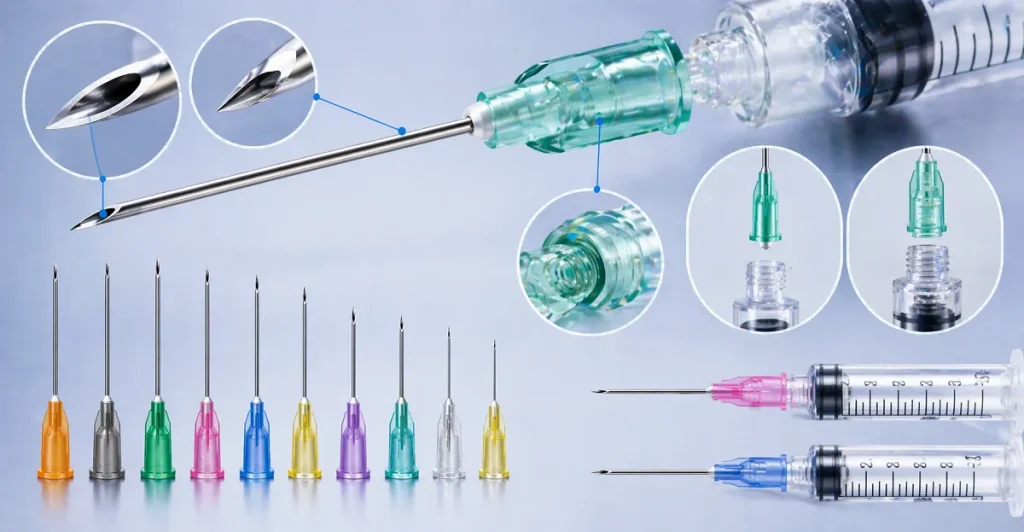
- Tecnologia Luer Lock: O nosso agulhas hipodérmicas com fecho luer lock apresentam um design de cubo roscado que se torce e encaixa de forma segura nas roscas correspondentes de uma seringa luer lock. Trata-se de uma necessidade absoluta para administrar medicamentos viscosos, extrair sangue espesso ou ligar a bombas de infusão IV automatizadas, onde as variações de pressão poderiam deslocar uma agulha de encaixe normal.
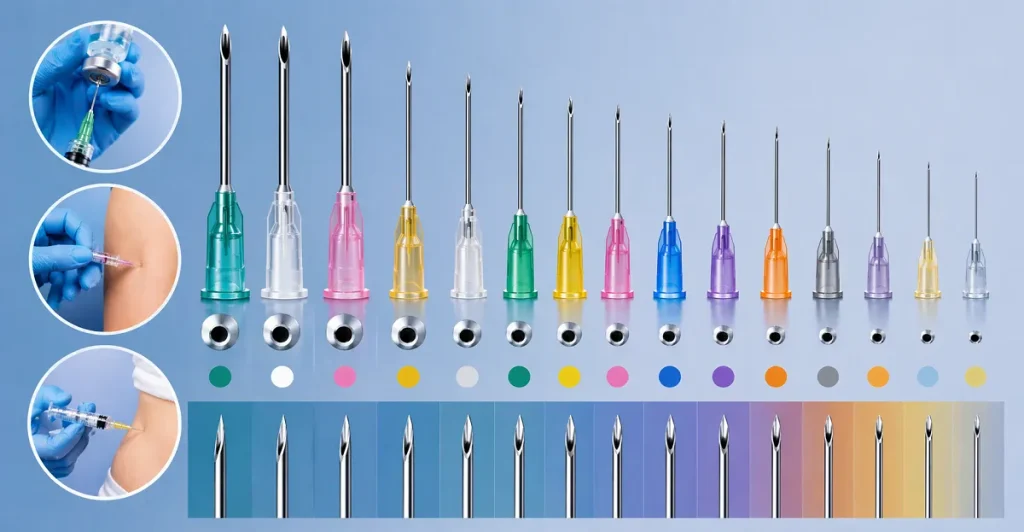
- Código de cores: Todos os hubs estão rigorosamente codificados por cores de acordo com ISO 6009 permitindo uma identificação rápida e visual do calibre da agulha por parte do pessoal clínico ocupado em ambientes de elevado stress.
C. Sistemas integrados de distribuição
Embora sejamos o principal fornecedor de agulhas autónomas, também fabricamos e embalamos sistemas completos e integrados. Os distribuidores podem adquirir quantidades a granel de agulhas e seringas hipodérmicas, ou optar por um produto pré-montado, embalado em blisters seringa hipodérmica com agulha para simplificar o fluxo de trabalho clínico, reduzir os resíduos de embalagens e minimizar o risco de contaminação durante a montagem.
III. Carteira de produtos: Classificação dos tipos de agulhas hipodérmicas por tamanho
O calibre do fio de Birmingham (BWG) é o padrão universal para a calibragem de agulhas. Funciona numa escala inversa: quanto mais baixo for o número do calibre, maior será o diâmetro exterior da agulha. As nossas linhas de fabrico são capazes de produzir uma vasta gama de tipos de agulhas hipodérmicas, satisfazendo exatamente as dimensões da agulha hipodérmica necessário para qualquer aplicação clínica, cosmética ou veterinária específica.
Segue-se uma análise pormenorizada da nossa carteira, categorizada por tamanhos de agulhas hipodérmicas e aplicações pretendidas, destacando as diâmetro da agulha hipodérmica para a exatidão das aquisições clínicas.
A. Série de grande calibre (Trauma, Banco de Sangue e Veterinária)
As agulhas de grande calibre requerem uma imensa integridade estrutural. São concebidas para penetrar em camadas dérmicas resistentes e facilitar o movimento rápido de fluidos de grande volume ou altamente viscosos. As nossas agulha hipodérmica de grande calibre produtos são obtidos a partir de produtos de qualidade superior Aço inoxidável 304 para garantir que nunca se deformarão sob força.
- Calibre 7 e calibre 12: Estes representam o extremo do espetro. A Agulha hipodérmica de calibre 7 (aprox. 4,5 mm de diâmetro exterior) e um Agulha hipodérmica de calibre 12 (aprox. 2,7 mm de diâmetro exterior) são raramente utilizados na medicina humana normal. São utilizados principalmente como agulhas hipodérmicas veterinárias para animais de grande porte (equinos, bovinos) para administrar pastas antibióticas espessas, ou em instrumentos especializados de biópsia/extração de medula óssea.
- Calibre 14 e calibre 16: O Agulha hipodérmica de calibre 14 (aprox. 2,1 mm de diâmetro externo, normalmente com um cubo verde claro) e o Agulha hipodérmica 16g (aprox. 1,6 mm de diâmetro externo, normalmente com um cubo branco) são ferramentas essenciais para salvar vidas. São o padrão para os compartimentos de trauma hospitalar e departamentos de emergência que requerem uma rápida reanimação com fluidos ou transfusões de sangue de emergência. Além disso, o 16G é o padrão global para linhas de recolha de bancos de sangue, uma vez que o lúmen largo evita o cisalhamento e a destruição de glóbulos vermelhos durante a doação de grandes volumes.
B. A série clínica padrão (flebotomia e injeção geral)
Estes instrumentos de medição são os mais utilizados pelos hospitais, laboratórios e clínicas de ambulatório em todo o mundo.
- Calibre 18 e calibre 20: O Agulha hipodérmica de calibre 18 (cubo cor-de-rosa, diâmetro externo de 1,2 mm) é o padrão universal para a preparação de medicamentos. Os enfermeiros utilizam-nas para retirar medicamentos espessos de frascos ou para misturar compostos intravenosos. O Agulha hipodérmica de calibre 20 (cubo amarelo, 0,9 mm de diâmetro externo) faz a ponte entre a preparação e os cuidados do doente, sendo frequentemente utilizada para pequenos procedimentos cirúrgicos, colocação de cateteres intravenosos e extração de sangue de veias saudáveis e robustas.
- Calibre 21, Calibre 23 e Calibre 24: Este grupo representa os cuidados de rotina dos doentes. O Agulha hipodérmica 21g (ponta verde, 0,8 mm de diâmetro externo) é a agulha mais comum utilizada para flebotomia de rotina e colheitas de sangue. A agulha Agulha hipodérmica 23g (cubo azul, 0,6 mm de diâmetro externo) é o padrão global para injecções intramusculares (IM), tais como injecções contra a gripe e COVID-19 vacinas, profundamente no músculo deltoide. Para os doentes com veias mais pequenas ou mais frágeis, a Agulha hipodérmica de calibre 24 (cubo roxo) proporciona um equilíbrio perfeito entre o fluxo de fluido e o conforto do doente.
C. Série Fine Gauge (Subcutânea, Cosmética e Diabética)
Concebida com paredes ultra-finas e revestimentos avançados de micro-silicone, a nossa série de calibre fino dá prioridade a uma experiência indolor para o doente no caso de injecções pouco profundas.
- Calibre 25 e calibre 27: O Agulha hipodérmica de 25g (núcleo cor de laranja, 0,5 mm de diâmetro externo) é amplamente utilizado para injecções subcutâneas e anestésicos locais. A Agulha hipodérmica de calibre 27 (cubo cinzento, 0,4 mm de diâmetro externo) é uma peça fundamental em clínicas dentárias para bloqueios de nervos, em dermatologia cosmética para injecções de Botox e preenchimentos dérmicos e em pediatria.
- Calibre 28 e calibre 30: Estas são as nossas micro-cânulas. As Agulha hipodérmica de calibre 28 e o ultrafino Agulha hipodérmica 30g (cubos amarelos/claros, 0,3 mm de diâmetro externo) são fabricados especificamente para agulha hipodérmica insulina solução de administração. Os doentes diabéticos necessitam de injecções diárias, muitas vezes múltiplas. Ao igualar a precisão e o conforto de marcas de consumo de primeira qualidade como agulhas hipodérmicas easy touch, Os nossos produtos OEM garantem uma penetração subcutânea sem dor e sem rasgar os tecidos.
Tabela de referência oficial: Especificações da agulha hipodérmica padrão
| Calibre | Norma de cor Hub (ISO 6009) | Diâmetro exterior nominal (mm) | Aplicação clínica primária |
| 12G | Sem padrão (frequentemente branco/claro) | 2,77 mm | Veterinária, Biópsia especializada |
| 14G | Verde pálido | 2,10 mm | Reanimação no trauma, linhas centrais |
| 16G | Branco | 1,65 mm | Banco de sangue, diálise |
| 18G | Cor-de-rosa | 1,27 mm | Preparação de medicamentos, transferência de fluidos |
| 20G | Amarelo | 0,90 mm | Inserção de cateteres IV, punção venosa |
| 21G | Verde profundo | 0,81 mm | Flebotomia normal / Colheita de sangue |
| 23G | Azul claro | 0,64 mm | Vacinas intramusculares (IM) |
| 25G | Laranja | 0,515 mm | Injecções subcutâneas, Anestesia local |
| 27G | Cinzento | 0,41 mm | Injectáveis cosméticos, Blocos dentários |
| 30G | Amarelo (Diabetic Std) | 0,31 mm | Administração de insulina, testes de alergia |
(Nota: As cores dos cubos seguem a norma ISO 6009, quando aplicável, mas as linhas para diabéticos e especialidades veterinárias podem utilizar sistemas de codificação de cores independentes com base nas preferências dos distribuidores regionais).
IV. Inovações em matéria de segurança e conformidade clínica
À medida que as redes globais de cuidados de saúde reforçam as suas normas regulamentares relativamente aos agentes patogénicos transmitidos pelo sangue, a procura de engenharia de segurança avançada tornou-se primordial. Fornecer uma peça de aço afiada já não é suficiente; o fabricante moderno tem de fornecer soluções integradas de mitigação de riscos.
A. Mandatos de utilização única e esterilização
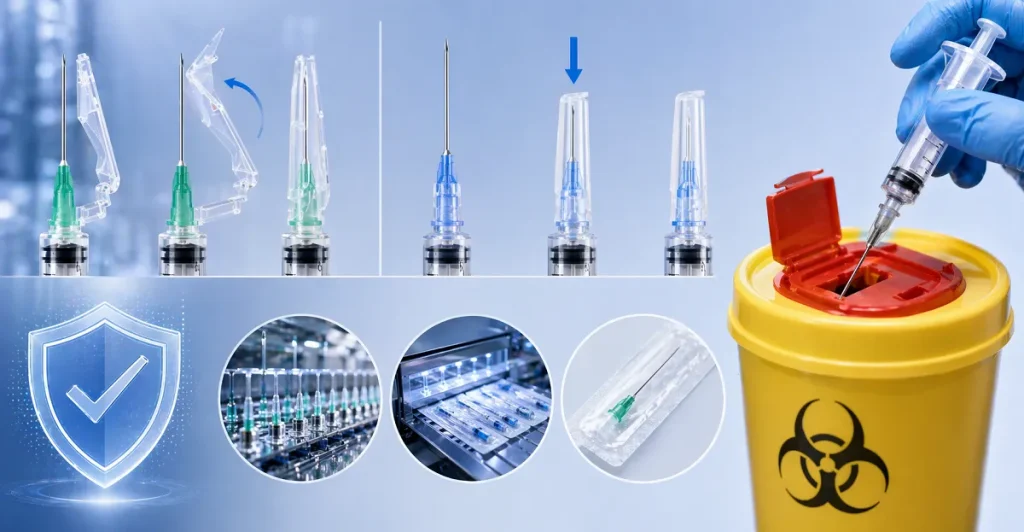
Todos os produtos que saem das nossas instalações são certificados como sendo estritamente de utilização única, agulhas hipodérmicas descartáveis unidade. A reutilização de agulhas é uma falha clínica catastrófica que resulta na transmissão do VIH, da hepatite B e da hepatite C. Garantimos uma reutilização perfeita das agulhas. agulha hipodérmica esterilizada através de processos automatizados e de grande volume de óxido de etileno (EtO) ou irradiação gama, juntamente com embalagens blister de qualidade médica utilizando materiais Tyvek para garantir a integridade absoluta da barreira durante um mínimo de 5 anos.
B. Proteção contra ferimentos provocados por material cortante (ESIP)
As agulhas acidentais são um risco profissional importante para enfermeiros e médicos. Para combater este problema, fabricamos uma linha completa de agulha hipodérmica de segurança produtos.
- Protectores de segurança com dobradiças: Produzimos agulhas com um braço de plástico integrado e articulado que o médico pode colocar sobre a agulha com uma única mão imediatamente após a injeção.
- Mecanismos retrácteis: Para aquisições de nível superior, oferecemos seringas retrácteis com mola, em que a agulha recua totalmente para dentro do corpo da seringa após a injeção. Os nossos mecanismos de segurança são concebidos para cumprir ou exceder os padrões de desempenho estabelecidos pelos produtos de segurança antigos, tais como o agulha hipodérmica de segurança magellan, A nossa empresa está a trabalhar em conjunto com os nossos clientes B2B, assegurando que os nossos clientes B2B podem oferecer uma conformidade de segurança de alto nível às suas redes hospitalares.
C. Protocolos pós-utilização
Apesar de concebermos as nossas agulhas para serem incrivelmente seguras antes e imediatamente após a sua utilização, defendemos vivamente a necessidade de eliminação de agulhas hipodérmicas protocolos. Todas as instalações clínicas devem depositar as agulhas usadas diretamente em contentores para material cortante à prova de perfuração aprovados pela FDA, para garantir a segurança absoluta das equipas de eliminação de resíduos biomédicos.
V. B2B Sourcing e Excelência no Fabrico Automatizado
Para redes médicas globais que avaliam fornecedores de agulhas hipodérmicas, Para além do produto físico, a matriz de decisão abrange a fiabilidade, a escalabilidade e o controlo de qualidade do parceiro de fabrico.
O que nos separa dos fornecedores genéricos do mercado é a nossa base na construção da própria maquinaria que produz os consumíveis. Uma vez que somos especialistas em equipamento de inspeção automatizado para linhas de produção médica, o nosso fabrico de agulhas é sujeito a uma triagem ótica rigorosa, em linha e a alta velocidade, que os inspectores humanos não conseguem igualar.
- Metalurgia de precisão: O nosso processo começa com tiras contínuas de aço inoxidável 304 ou 316L de qualidade cirúrgica. A tira é enrolada num tubo preciso e soldada por TIG numa atmosfera de árgon inerte para evitar a oxidação.
- Desenho a frio: O tubo é estirado repetidamente através de matrizes de carboneto, reduzindo sistematicamente o seu diâmetro e espessura de parede para obter dimensões de calibre exactas, ao mesmo tempo que alinha a estrutura de grãos do aço para obter a máxima resistência à tração.
- Retificação automática de chanfros: Utilizando rebolos CNC avançados, cada ponta é cortada em ângulos primários e secundários óptimos. Os nossos sistemas de inspeção ótica automatizados rejeitam instantaneamente qualquer agulha com uma rebarba microscópica, ponta em “anzol” ou extremidade romba.
- Siliconização: As cânulas são revestidas com uma micro-camada de silicone de grau médico, que reduz a fricção. Isto assegura que a agulha desliza através da pele, minimizando a dor e o traumatismo dos tecidos.
- Montagem e colagem automatizadas: A cânula é acoplada ao encaixe luer utilizando epóxi médico curado por UV, testado para suportar uma força de tração significativa sem se soltar.
O nosso compromisso com o fabrico sem defeitos significa que quando um distribuidor clínico encomenda dez milhões de unidades de uma agulha 21G, cada unidade terá um desempenho idêntico. Esta é a marca registada do fabrico médico B2B profissional.

VI. Perguntas mais frequentes (P&R)
Para ajudar os responsáveis pelas aquisições, os representantes de vendas de distribuição e os técnicos biomédicos, compilámos as perguntas mais frequentes sobre os nossos processos de fabrico, especificações de produtos e utilização clínica.
Uma agulha hipodérmica é um instrumento médico oco e altamente especializado, concebido para ser ligado a uma seringa. A palavra “hipodérmica” traduz-se literalmente por “debaixo da pele”. Ao contrário das agulhas sólidas utilizadas para costura ou sutura cirúrgica (que apenas passam o fio através de um substrato), o núcleo oco (conhecido como lúmen) de uma agulha hipodérmica permite aos profissionais médicos injetar medicamentos líquidos, vacinas ou fluidos intravenosos diretamente nos tecidos ou no sistema vascular do corpo. Por outro lado, permite a extração precisa de fluidos corporais, como o sangue, para testes laboratoriais de diagnóstico.
A diferença reside na forma como o cubo da agulha se liga ao corpo da seringa. Uma agulha Luer Lock possui pequenas roscas internas de plástico no interior do cubo que lhe permitem torcer e prender-se firmemente à ponta roscada de uma seringa Luer Lock. Isto evita que a agulha salte durante injecções de alta pressão ou quando se extraem fluidos espessos. Uma agulha Luer Slip desliza simplesmente e utiliza a fricção para se manter na ponta da seringa. Para as aplicações médicas mais críticas, especialmente as que envolvem medicamentos viscosos ou acesso vascular, a Luer Lock é a norma preferida.
A agulha hipodérmica moderna foi inventada independentemente em 1853 pelo médico escocês Alexander Wood e pelo cirurgião francês Charles Pravaz. Wood desenvolveu uma agulha oca ligada a um êmbolo para injetar morfina para alívio localizado da dor, enquanto Pravaz criou um mecanismo semelhante de seringa de prata. As suas inovações revolucionárias abriram caminho para os instrumentos médicos de precisão, fabricados em massa em aço inoxidável, utilizados atualmente em hospitais e clínicas em todo o mundo.
O “G” significa Gauge (calibre), referindo-se especificamente ao sistema Birmingham Wire Gauge (BWG) utilizado para medir o diâmetro exterior dos tubos médicos. O sistema de calibre funciona numa escala inversa: quanto maior for o número do calibre, mais fina é a agulha. Por exemplo, uma agulha 30G é uma agulha ultrafina agulha utilizada para a insulina, enquanto uma agulha 14G é uma agulha muito grossa utilizada para a reanimação rápida de trauma.
A redução da dor do doente é o resultado de três técnicas de fabrico específicas. Em primeiro lugar, a agulha é esmerilada com uma ponta multibifurcada (normalmente três ângulos distintos) que lhe permite separar as fibras dos tecidos suavemente em vez de as rasgar. Em segundo lugar, a agulha é submetida a um processo de electropolimento para remover quaisquer rebarbas microscópicas ou arestas dentadas. Finalmente, toda a cânula é revestida com uma camada microfina de lubrificante de silicone de grau médico, que reduz drasticamente a fricção à medida que a agulha atravessa as camadas dérmicas.
As agulhas usadas representam um risco biológico significativo e nunca devem ser deitadas no lixo doméstico ou comercial normal. Imediatamente após a utilização, a agulha (e a seringa anexa) deve ser colocada diretamente num recipiente de eliminação de material cortante designado, rígido e à prova de perfuração, aprovado pela FDA. Quando o contentor estiver cheio até à linha indicada, deve ser selado e eliminado de acordo com os regulamentos locais relativos a resíduos biomédicos, o que geralmente envolve a incineração ou a esterilização em autoclave por serviços especializados de recolha de resíduos médicos.
Quando fabricada, esterilizada e embalada corretamente em blisters de qualidade médica (normalmente uma combinação de papel médico/Tyvek e uma película de plástico), uma agulha hipodérmica descartável tem geralmente um prazo de validade oficialmente certificado de 5 anos a partir da data de esterilização. Este prazo de validade só é válido se a embalagem não estiver rasgada, perfurada, danificada pela água ou exposta a uma degradação ambiental extrema. Se a embalagem estiver comprometida, a agulha deixa de ser considerada estéril.
As agulhas hipodérmicas são fabricadas através de um processo de engenharia de precisão altamente automatizado. Começa com uma tira plana de aço inoxidável de qualidade cirúrgica que é enrolada num tubo e fechada por soldadura a laser. Este tubo é repetidamente estirado através de um molde (um processo chamado estiramento a frio) para o esticar e reduzir o seu diâmetro para o calibre exato desejado. Os tubos são então cortados à medida e uma extremidade é rectificada com precisão em vários ângulos para criar uma ponta biselada e afiada como uma navalha. Finalmente, são fixados a um cubo de plástico através de epóxi, lubrificados com silicone de grau médico para uma inserção suave, esterilizados através de gás óxido de etileno e selados em embalagens blister.
🔗 Visite-nos:https://topkeymedical.com/
📧 Correio eletrónico:info@topkeymedical.com