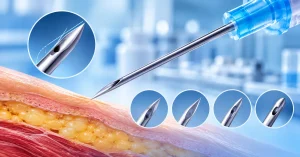








In medical device manufacturing and pharmaceutical packaging, choosing the right needle goes far beyond selecting a nominal gauge size. Two needles labeled as 25G or 30G share the exact same outer diameter, yet they can deliver dramatically different injection forces, fluid flow rates, structural stiffness, and patient comfort levels. The decisive variable separating their performance is cannula wall thickness.
For medical consumable procurement directors, R&D engineers, pharmaceutical formulation teams, and OEM equipment buyers, understanding the engineering trade-offs between regular wall needles, thin wall needles, and ultra-thin wall needles is critical. As biologic drugs grow more viscous and patient self-injection devices demand finer, less painful gauges, cannula wall architecture has become one of the most important specifications in modern needle design and automated manufacturing.
This technical guide breaks down the dimensional standards, fluid dynamics, structural mechanics, and precision manufacturing challenges behind regular, thin, and ultra-thin wall cannulas.
1. Introduction: Why Cannula Wall Thickness Matters in Modern Healthcare
The Clinical and Engineering Paradox
Medical needle design faces a persistent physical conflict. On one hand, clinicians and patients want the smallest possible outer diameter (high gauge number) to minimize skin puncture trauma, nerve receptor activation, bruising, and procedural anxiety. On the other hand, clinical procedures and pharmaceutical therapies require rapid, predictable fluid transfer—whether drawing venous blood without damaging red blood cells or injecting thick biologic medications within a comfortable timeframe.
Traditionally, increasing fluid flow meant stepping down to a larger needle gauge (for example, moving from a 27G needle to a wider 23G needle). However, a larger outer diameter directly increases insertion pain and tissue displacement.
Decoupling Outer Diameter from Inner Diameter
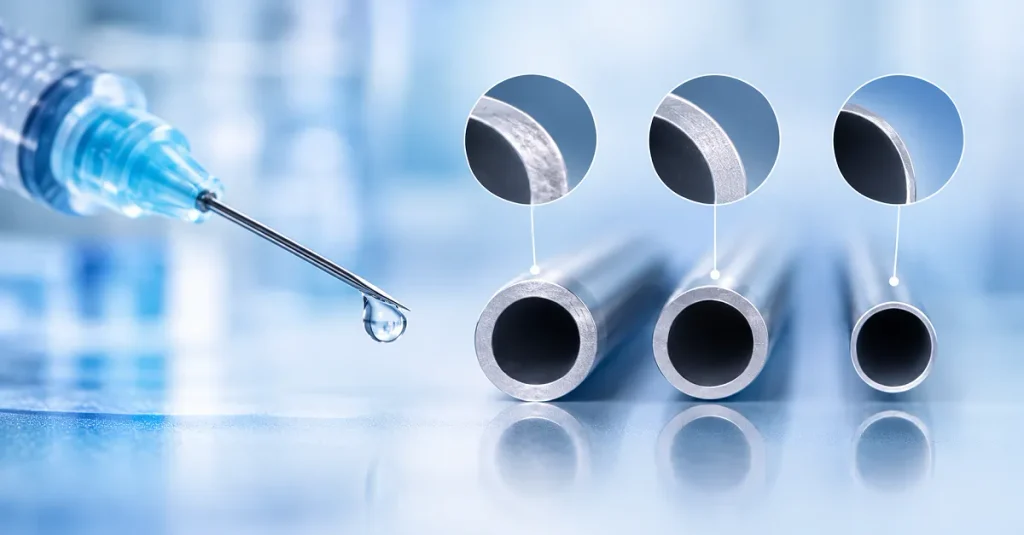
Advancements in stainless steel cold-drawing metallurgy solved this dilemma by decoupling the needle’s Outer Diameter (OD) from its Inner Diameter (ID). By drawing medical-grade stainless steel tubing to tighter concentric tolerances and higher tensile strength, manufacturers can reduce the thickness of the metal wall while keeping the external gauge size unchanged. This expands the internal fluid bore, allowing a finer needle to perform with the flow efficiency of a much larger gauge.
Regulatory Foundations: ISO 9626
Global cannula dimensions are governed by ISO 9626 (Stainless steel needle tubing for the manufacture of medical devices). This standard establishes nominal outer diameters, minimum inner diameters, and wall-thickness designations across metric sizes from 0.18 mm (34G) up to 3.4 mm (10G), ensuring dimensional interchangeability and structural safety across global medical supply chains.
2. Core Classifications Defined: Structural and Dimensional Breakdown
A. Regular Wall Needles (RW)
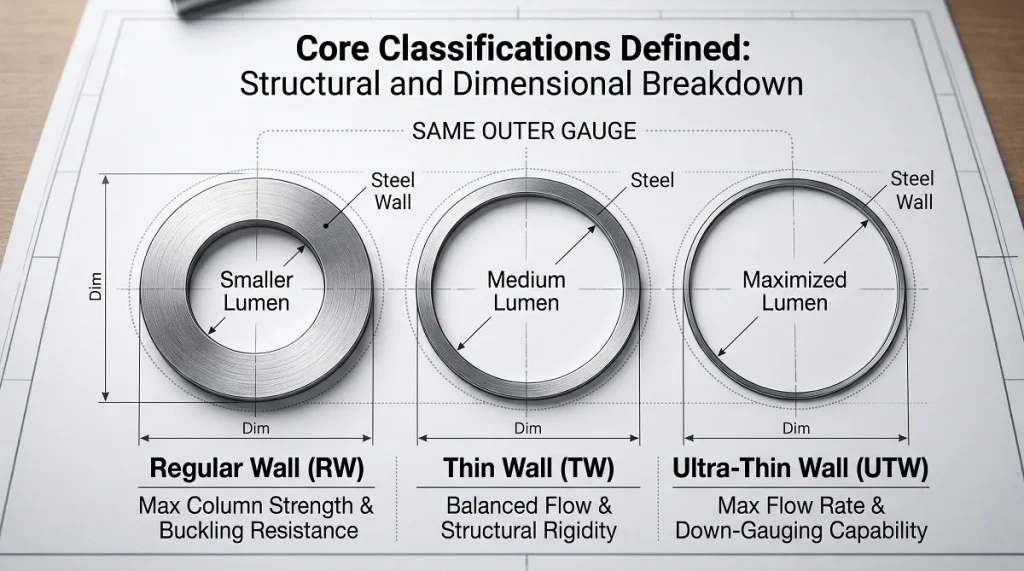
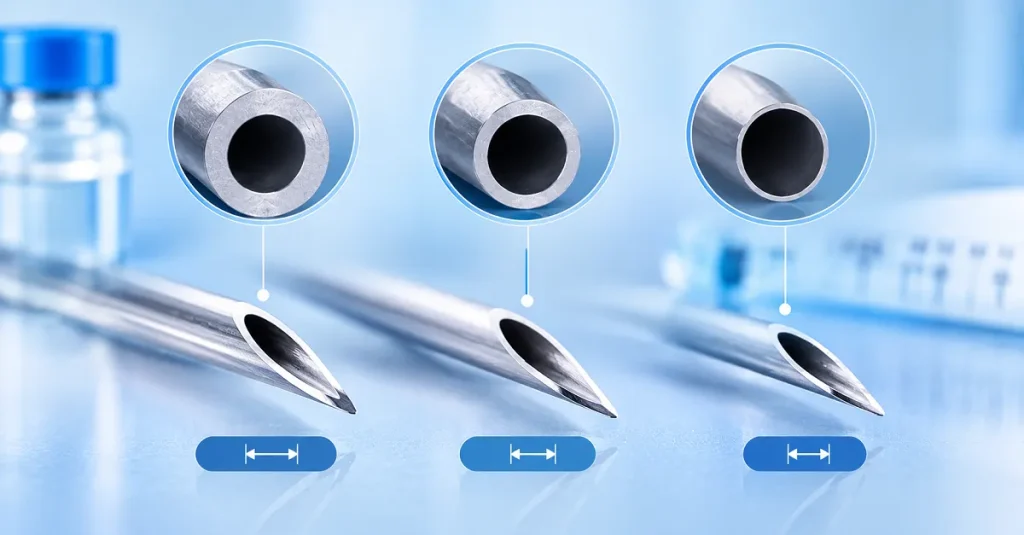
Regular wall needles represent the traditional baseline specification in medical tubing. They feature the thickest metal wall for any given outer gauge, leaving a comparatively narrow internal lumen.
Mechanical Behavior: Regular wall cannulas deliver maximum column strength, bending stiffness, and resistance to axial buckling. When pushed through dense anatomical structures or thick rubber vial stoppers, an RW shaft tracks straight with minimal lateral deflection.
Başlıca Kullanım Alanları: Deep intramuscular (IM) injections, spinal and epidural anesthesia needles, bone marrow biopsy trocars, veterinary needles, and heavy-duty fluid transfer or industrial dispensing tips.
B. Thin Wall Needles (TW)
Thin wall needles reduce the cannula wall thickness while preserving the exact same outer diameter as an RW needle of the same gauge. This expands the internal bore diameter by roughly 15% to 25% depending on the gauge size.
Mechanical Behavior: Thin-wall tubing strikes an engineering balance between structural rigidity and fluid dynamics. While slightly more flexible than regular wall cannulas, high-tensile cold-worked stainless steel ensures sufficient stiffness for routine clinical penetration.
Başlıca Kullanım Alanları: Standard venipuncture and blood collection needles, routine hypodermic syringes, pediatric and geriatric vascular access, and general infusion sets.
C. Ultra-Thin Wall Needles (UTW) and Extra-Thin Wall (ETW)
Ultra-thin wall needles (along with specialized Extra-Thin Wall variants) push stainless steel drawing technology to its mechanical limits. Wall thickness is reduced to micro-dimensions—frequently between 0.035 mm and 0.055 mm—maximizing the internal lumen cross-section.
Mechanical Behavior: UTW needles offer the highest possible flow rate and lowest injection glide force for a given external needle size. Because the metal wall is exceptionally thin, the tubing relies heavily on high-yield austenitic stainless steel temper to prevent tube ovality, kinking, or tip deformation.
Başlıca Kullanım Alanları: Deri altı insulin pen needles (31G to 34G), pre-filled syringes (PFS) and autoinjectors for viscous biologics (monoclonal antibodies), aesthetic dermal fillers (cross-linked hyaluronic acid), and high-flow hemodialysis arteriovenous fistula (AVF) needles.
3. The Physics of Flow: Hagen-Poiseuille Law and Injection Force
To understand why a seemingly microscopic increase in inner diameter transforms clinical performance, engineers look to fluid dynamics—specifically the Hagen-Poiseuille Law for laminar flow through a cylindrical tube.
THE FOURTH-POWER FLOW ADVANTAGE

Volumetric Flow Rate (Q) is proportional to Inner Radius to the 4th Power (r^4)

Example: Increasing Inner Diameter (ID) by just 20% (1.2x)
1.2 x 1.2 x 1.2 x 1.2 = 2.07x Volumetric Flow Rate (More than Double!)
According to this physical principle, the volumetric flow rate (Q) of a fluid passing through a cannula is proportional to the fourth power of the internal radius:
Flow Rate (Q) = (Pressure Difference x Pi x Internal Radius to the 4th Power) / (8 x Fluid Viscosity x Cannula Length)
Because radius is raised to the fourth power, even a minor expansion of the inner bore produces an exponential jump in fluid throughput—or, conversely, a dramatic drop in the pressure required to push fluid through the needle.
Impact on Viscous Biologics and Autoinjectors
Modern biologic therapies—such as monoclonal antibodies (mAbs) and protein therapeutics—often exhibit high viscosities ranging from 15 to over 50 centipoise (cP), compared to water at 1 cP. Pushing a viscous biologic through a standard regular wall 27G needle requires excessive thumb force on a manual syringe or overloads the spring mechanism in a wearable autoinjector.
Switching to an ultra-thin-wall 27G or 29G cannula cuts plunger glide force by 40% to 60% and shortens injection duration from over 20 seconds down to under 8 seconds. Furthermore, wider internal lumens reduce wall shear stress during high-pressure delivery, protecting fragile therapeutic proteins from shear-induced aggregation or molecular degradation.
Impact on Phlebotomy and Hemodialysis
In diagnostic blood collection, forcing red blood cells through a narrow, regular-wall lumen under vacuum pressure creates high fluid shear stress, which can rupture erythrocytes (hemolysis) and invalidate laboratory potassium or lactate test results. Thin-wall and ultra-thin wall phlebotomy needles allow rapid vacuum tube filling while maintaining gentle laminar blood flow. Similarly, in hemodialysis, UTW AVF needles enable high blood pump flow rates (350 to 500 mL/min) without requiring clinicians to use painfully large 14G or 15G cannulas.

4. Dimensional and Engineering Comparison Matrix (ISO 9626 Reference)
The table below illustrates how outer diameters remain constant across each gauge while inner diameters expand significantly from Regular Wall to Ultra-Thin Wall specifications:
| İğne Ölçer | Nominal Outer Diameter (OD) | Regular Wall (RW) Nominal ID | Thin Wall (TW) Nominal ID | Ultra-Thin Wall (UTW) Nominal ID | Primary Clinical and Pharmaceutical Advantage |
| 18G | 1,27 mm | 0.84 mm | 0.96 mm | 1.06 mm | Rapid fluid transfer, high-flow aspiration, vascular access |
| 21G | 0.82 mm | 0,51 mm | 0.58 mm | 0.65 mm | Standard phlebotomy with reduced red blood cell hemolysis |
| 23G | 0,64 mm | 0.33 mm | 0.39 mm | 0.46 mm | Fragile vein blood draw and pediatric IV infusion |
| 25G | 0,51 mm | 0.25 mm | 0,30 mm | 0.35 mm | Subcutaneous biologics and low-pain vaccine delivery |
| 27G | 0,41 mm | 0.19 mm | 0,23 mm | 0.27 mm | Cross-linked dermal fillers, dental, and ophthalmic injection |
| 30G | 0,31 mm | 0.14 mm | 0,16 mm | 0.19 mm | Mesotherapy, botulinum toxin, and viscous self-injection |
| 32G | 0,23 mm | 0.09 mm | 0.11 mm | 0.13 mm | Ultra-low-pain daily insulin pen self-administration |
Note: Dimensional values represent standard nominal benchmarks aligned with ISO 9626 tolerances. Specific minimum and maximum ID tolerances vary based on custom tube-drawing specifications.
5. Structural Trade-Offs: Stiffness, Buckling, and Tip Integrity
While ultra-thin wall needles offer clear fluidic benefits, removing metal from the cannula wall alters its mechanical behavior. Engineers must carefully balance flow gains against three structural trade-offs:
1. Column Buckling and Bending Deflection
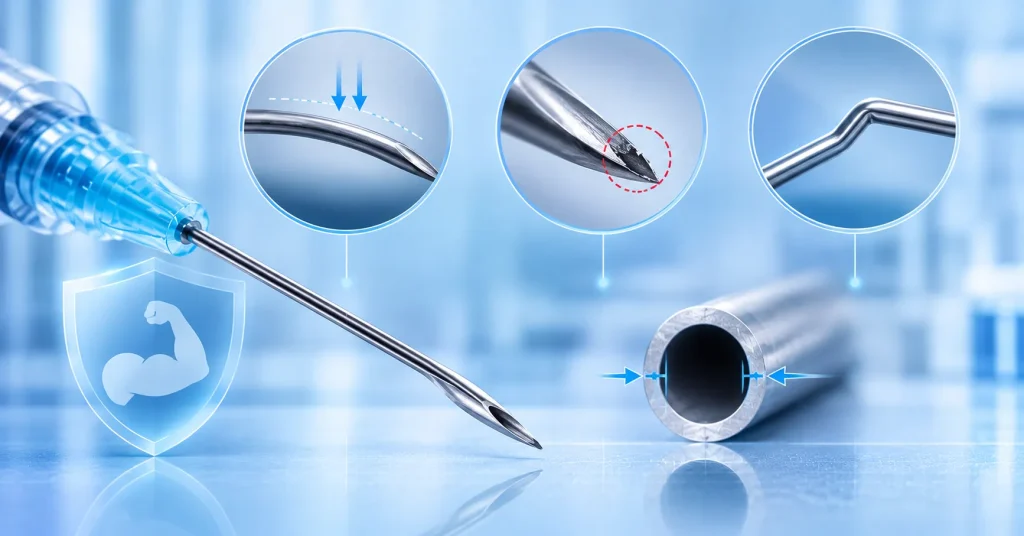
A needle’s resistance to bending is governed by its area moment of inertia, which scales with the fourth power of the outer diameter minus the fourth power of the inner diameter. When the inner diameter expands in a UTW cannula, the structural cross-section decreases. On longer cannulas (such as 1.5-inch intramuscular needles or 3.5-inch spinal needles), an ultra-thin wall is more prone to lateral deflection (“skiving”) when passing through dense fascia or muscle planes, and carries a lower critical buckling load under axial compression.
2. Bevel Tip Curling (“Fish-Hooking”)
At the distal lancet point, the metal tapers down to a microscopic edge. Because ultra-thin wall cannulas have less supporting wall mass behind the bevel facets, the sharp apex is more vulnerable to plastic tip curling if it strikes tough keratinized skin, calcified tissue, or dense chlorobutyl rubber vial stoppers. Preventing tip hooks requires precision multi-axis CNC bevel grinding combined with optimized lancet angles.
3. Kinking and Lumen Collapse
If a thin-walled tube is subjected to sharp lateral bending forces or excessive radial clamping pressure during assembly, it can kink rather than flex elastically. High-tensile cold-working of the stainless steel alloy is essential to raise the yield point and prevent permanent deformation.
Performance Comparison Across Wall Architectures
| Engineering Metric | Regular Wall (RW) | Thin Wall (TW) | Ultra-Thin Wall (UTW) |
| Volumetric Flow Efficiency | Baseline (Lowest for gauge) | Moderate (+30% to +60% over RW) | Maximum (+80% to +150% over RW) |
| Injection Plunger Glide Force | High (with viscous fluids) | Orta düzeyde | Low (Ideal for autoinjectors) |
| Column Buckling Resistance | Maksimum | Yüksek | Moderate (Best for short lengths) |
| Lateral Bending Stiffness | Maksimum | Orta ila Yüksek | Lower (Requires high-tensile alloy) |
| Tip Curling (“Fish-Hook”) Resistance | Yüksek | Orta ila Yüksek | Requires precision CNC grinding |
| Down-Gauging Potential | None | Moderate (1 gauge step finer) | High (1 to 2 gauge steps finer) |
| Raw Tubing and Processing Cost | Lowest | Orta düzeyde | Highest (Tight drawing tolerances) |
6. Manufacturing Challenges in Thin and Ultra-Thin Wall Production
Producing reliable thin wall and ultra-thin wall needles at commercial volumes of tens of thousands of units per hour requires advanced metallurgical control and specialized automation equipment.
CRITICAL MANUFACTURING CHECKPOINTS FOR UTW NEEDLES

[ High-Tensile Cold-Drawn AISI 304 / 316L Tubing ]
       │  (Strict concentricity & wall uniformity check)
       ▼
[ Multi-Axis CNC Needle Grinding Machine ]
       │  (Low-force V-block clamping + flood coolant to avoid thermal softening)
       ▼
[ Electrochemical Deburring & Micro-Siliconization ]
       │  (Burr-free heel + ISO 7864 silicone layer for low glide force)
       ▼
[ Automated Hub Assembly & Precision UV Adhesive Dispensing ]
       │  (Controlled viscosity glue to prevent capillary wicking into wide UTW bore)
       ▼
[ 360-Degree High-Speed Machine Vision Inspection (AOI) ]
          (Inline screening for wall ovality, tip hooks, and lumen occlusion)
Precision Tube Drawing and Metallurgy
UTW cannulas are manufactured from seamless or laser-welded, cold-drawn austenitic stainless steel—typically AISI 304 for superior tensile strength (1,800 to 2,200+ MPa) or AISI 316L for enhanced corrosion resistance against aggressive pharmaceutical formulations. Tube mills must hold wall concentricity within tight tolerances; if a 0.040 mm wall is off-center by even 0.008 mm, one side becomes structurally weak and prone to splitting or collapsing.
CNC Grinding and Low-Force Clamping
During tip grinding, cannulas are held in parallel arrays inside precision V-block fixtures. Standard high-pressure mechanical clamps designed for regular wall tubing will crush or ovalize ultra-thin wall tubes. Modern multi-axis CNC needle grinding machines utilize calibrated pneumatic or hydraulic equalizing fixtures that grip delicate tubes firmly without distorting roundness, paired with refrigerated synthetic coolants to prevent heat from annealing the thin metal tip.
Automated Hub Assembly and Glue Wicking Control
When bonding a cannula into a plastic Luer hub or pen needle screw-thread hub, automated assembly machines dispense a precise micro-drop of UV-curable medical adhesive. Because UTW cannulas have wider internal lumens and thinner walls, adhesive viscosity and dispensing volume must be tightly controlled to prevent capillary wicking into the rear of the cannula bore, which would block fluid flow.
360-Degree Optical Vision Inspection
Inline Automated Optical Inspection (AOI) stations use high-resolution telecentric cameras to inspect 100% of finished UTW needles at high speeds. Vision algorithms verify lancet facet symmetry, detect micro-burrs or inverted apex hooks smaller than 5 micrometers, and confirm clear inner lumen passage.

7. Selection and OEM Sourcing Guide: Choosing the Right Wall Thickness
When specifying cannula parameters for a new medical consumable or drug delivery device, engineering and procurement teams can follow this practical selection framework:
When to Specify Regular Wall Needles (RW)
- Deep Tissue Access: Needles longer than 38 mm (1.5 inches) where straight tracking and column stiffness are critical.
- High Mechanical Load: Piercing thick multi-dose rubber vial stoppers, dense scar tissue, or bone cortex.
- Cost-Sensitive Standard Disposables: High-volume general-purpose hypodermic needles delivering low-viscosity aqueous solutions.
When to Specify Thin Wall Needles (TW)
- Routine Venipuncture and Blood Collection: Accelerating blood draw times while protecting sample integrity against hemolysis.
- General Clinical Upgrades: Enhancing flow rates on standard syringes without altering established clinical handling feel or stiffness.
When to Specify Ultra-Thin Wall Needles (UTW)
- High-Viscosity Biologics and Dermal Fillers: Reducing injection glide force and patient injection time for thick monoclonal antibodies, peptides, or hyaluronic acid gels.
- Patient Down-Gauging Strategies: Moving from a 27G RW needle to a 29G or 30G UTW needle to achieve the same flow rate with significantly less insertion pain—improving patient adherence in chronic self-injection therapies.
- Short Cannula Lengths: Subcutaneous pen needles (4 mm to 8 mm) and intradermal micro-needles, where short shaft length naturally eliminates column buckling concerns.
OEM / ODM RFQ Checklist
Before requesting quotes from cannula suppliers or needle assembly equipment manufacturers, verify these six specifications:
- ISO 9626 Compliance: Exact outer diameter, minimum inner diameter, and wall designation (RW, TW, UTW, or custom).
- Alloy Grade and Temper: AISI 304 vs. 316L and required tensile yield strength (MPa).
- Concentricity Tolerance: Maximum allowable wall thickness variation around the circumference.
- Bevel Geometry: Primary and secondary lancet grind angles (3-bevel vs. 5-bevel) and heel anti-coring treatment.
- Surface Finish and Lubrication: Inner/outer surface roughness (Ra less than 0.1 micrometers) and ISO 7864 medical-grade siliconization weight.
- Cleanroom and Validation Standards: ISO 13485 certification, particulate cleanliness testing (USP 788), and sterilization compatibility (EtO or Gamma).
8. Frequently Asked Questions (FAQs)
All three needle types share the same Outer Diameter (OD) for a given gauge size, meaning they create the same size skin puncture. The difference lies in the thickness of the stainless steel tubing wall: regular wall needles have the thickest metal wall for maximum stiffness, thin wall needles have a thinner wall to expand the inner bore, and ultra-thin wall needles have the thinnest possible wall to maximize inner lumen diameter and fluid flow rate.
Because fluid flow rate increases proportionally to the fourth power of the needle’s inner radius, an ultra-thin wall 29G or 30G needle can have nearly the same internal bore diameter as a standard regular wall 27G needle. This enables pharmaceutical and device manufacturers to switch to a finer, less painful outer gauge (“down-gauging”) while maintaining the exact same injection time and plunger force.
No, provided the cannula is manufactured from medical-grade, cold-worked austenitic stainless steel (such as AISI 304 or 316L) compliant with ISO 9626. High-tensile stainless steel tubing undergoes strict ductility and breakage resistance testing. While a UTW needle will bend more easily than a regular wall needle if subjected to lateral force, it will flex rather than snap brittlely under normal clinical use.
Biologic medications (such as monoclonal antibodies) and aesthetic hyaluronic acid fillers have high fluid viscosities. Pushing thick fluids through a narrow regular wall needle creates excessive back-pressure, high thumb force, long injection times, and potential shear damage to delicate protein molecules. Ultra-thin-wall cannulas dramatically lower flow resistance, making manual and autoinjector delivery smooth and predictable.
Cannula dimensions and wall thickness categories are governed by ISO 9626 (Stainless steel needle tubing for the manufacture of medical devices). ISO 9626 defines the nominal outer diameters, minimum inner diameters, stiffness requirements, and breakage resistance thresholds for Regular Wall, Thin Wall, and Extra/Ultra-Thin Wall medical tubing.
Ultra-thin wall tubing requires tighter concentricity tolerances during cold drawing so the wall does not become uneven or collapse. During tip grinding, multi-axis CNC needle grinders must use low-force equalizing clamps to avoid crushing the thin tube into an oval shape. During automated hub assembly, UV adhesive dispensing must be tightly controlled so glue does not wick into the wider internal bore.
In blood collection, vacuum pressure pulls blood rapidly through the needle lumen. Narrow, regular wall lumens create higher fluid velocity gradients and wall shear stress, which can rupture red blood cells (causing hemolysis) and skew diagnostic lab results. Thin-wall and ultra-thin wall phlebotomy needles provide a wider, gentler flow path that fills collection tubes faster while minimizing hemolysis.
Regular wall needles are the superior choice whenever structural rigidity and buckling resistance outweigh flow speed. This includes long needles (over 1.5 inches), deep intramuscular injections, spinal or biopsy needles, veterinary applications, and transfer needles used to pierce thick rubber vial stoppers where an ultra-thin tip might curl or bend.