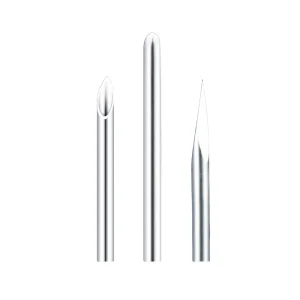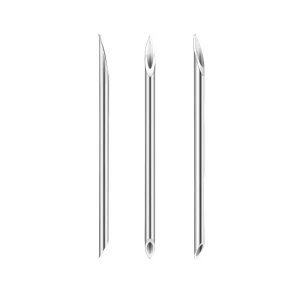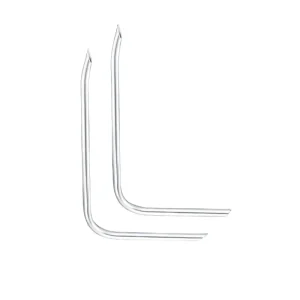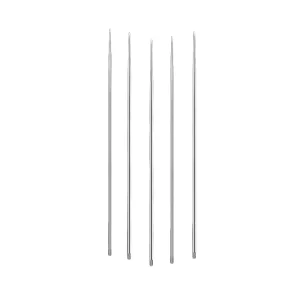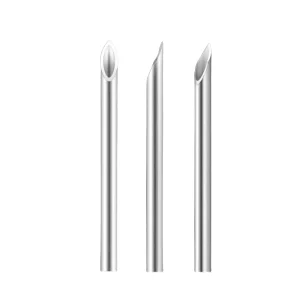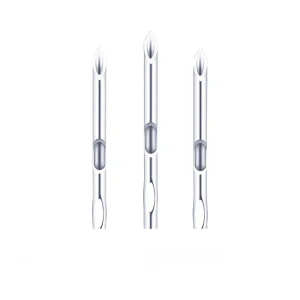






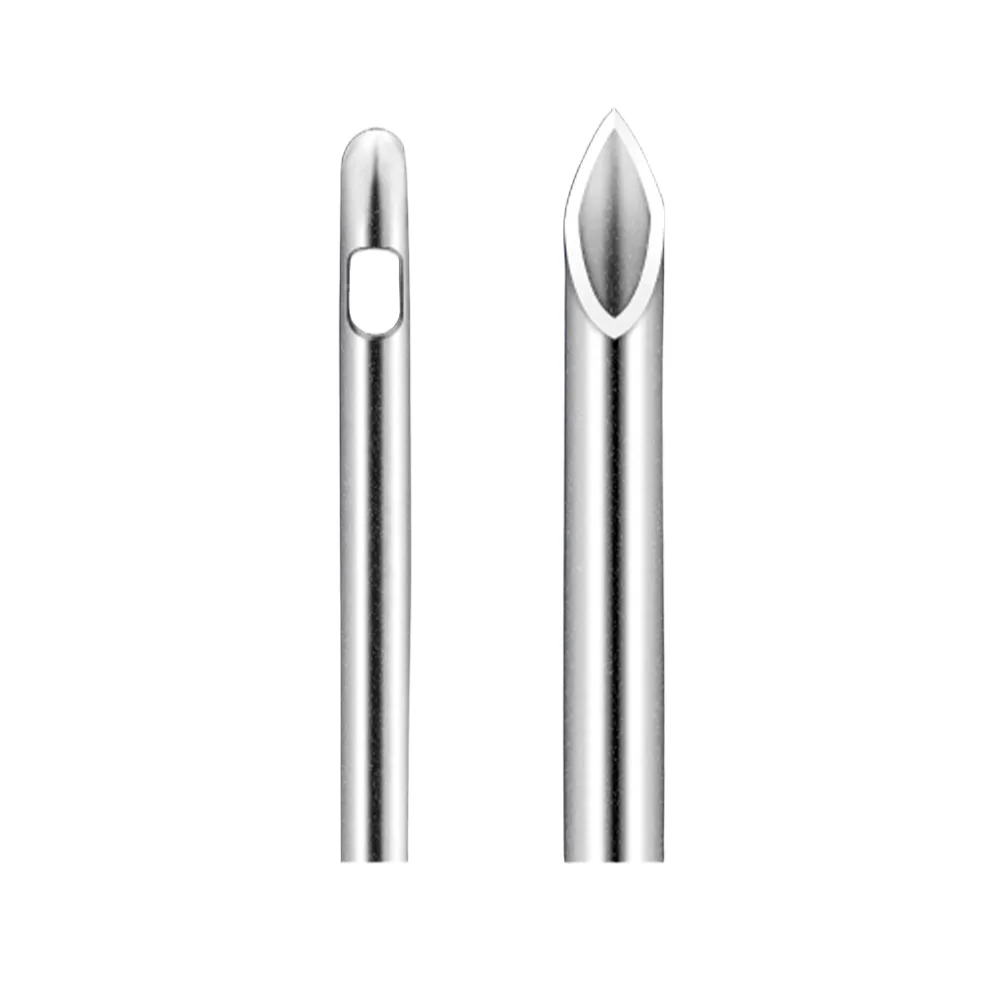
Block Needle, Plugging Needle
SPECIFICATIONS
Technical Parameters
Technical Specifications
| Parameter | Specification |
|---|---|
| Product Name | Block Needle / Plugging Needle (Occlusion Needle) |
| Material – Cannula | Medical-grade SUS304 stainless steel; optional polymer sheath |
| Gauge Range (OD) | 18G – 25G (1.2 mm – 0.5 mm) depending on occlusion type |
| Length Options | 50 mm – 200 mm (±1 mm tolerance) |
| Tip Design | Blunt, rounded, or flat-ended (to hold plug material or block medium) |
| Occlusion Mechanism | Supports gelatin sponge, embolic particles, or custom plugs |
| Handle / Hub | Standard Luer-lock or textured anti-slip hub |
| Surface Finish | Mirror-polished stainless steel; smooth for controlled insertion |
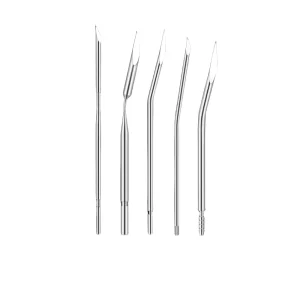
| Curvature Options | Straight or pre-bent for targeted navigation |
| Sterilization Method | Ethylene Oxide (EO) or Gamma sterilized |
| Packaging | Individually sterile blister pack, 10 pcs per box |
| Single-Use | Yes |
| Certifications | ISO 13485, CE, FDA (depending on market region) |
| Shelf Life | 3–5 years under proper storage conditions |
Block Needle (Plugging Needle): Precision Vascular Occlusion for Minimally Invasive Interventions
Clinical Purpose
Engineered for reliable vessel sealing and targeted tissue occlusion, the Block Needle delivers controlled closure during interventional radiology, biopsy tract sealing, and embolization therapies. It enables physicians to rapidly isolate blood vessels or ducts (e.g., biliary, fallopian tubes) while minimizing collateral tissue damage.
Critical Advantages
Dual-Mode Occlusion
– Sharp-tip penetration: Ultra-bevelled 15° tip for smooth tissue entry.
– Blunt-tip expansion: Deployable micro-plug creates instant 3D occlusion.
Enhanced Safety
– Depth-specific radiopaque markers (every 5mm) under fluoroscopy.
– Torque-control hub prevents accidental over-advancement.
Procedural Efficiency
– 30% faster vessel sealing vs. manual compression.
– Luer-Lock compatibility for simultaneous embolic agent delivery.
Advanced Material Engineering
– Core: Medical 304L stainless steel (OD tolerance: ±0.02mm).
– Surface: Hydrophilic polymer coating (contact angle: 18°) reduces friction by 40%.
– Visibility: Distal tungsten tip (20% density) for CT/MRI compatibility + laser-etched echogenic bands for ultrasound guidance.
Applications
– Biopsy tract closure (liver/kidney)
– Pre-embolization vessel blocking
– Microvascular leakage control in reconstructive surgery
– Non-surgical sterilization procedures
Compliance & Customization
– Sterile EO gamma-packed | ISO 13485 | FDA 21 CFR 880.5570
– Gauge range: 18G–25G | Lengths: 5cm–20cm
– OEM options: Coil-reinforced shafts | Antibacterial coatings
FEATURES
Customization Advantages
Precision engineering for complex medical applications
Geometry Expertise
J-hooks, helical coils, side ports, multi-lumen structures, or patient-specific bends. Micro-barb retention elements, fluid channels (≥50μm ID), or directional drug delivery windows.
Advanced Manufacturing
Laser micromachining precision ±5μm. Electroforming for seamless tapered transitions. Nitinol shape-memory integration for steerable functionality.
Rapid Prototyping
Surgical-grade steel / PEEK 3D-printed prototypes delivered within 72 hours. CFD and structural simulation reports to accelerate product validation.
Ready to Discuss Your Custom Requirements?
RELATED PRODUCTS
Related Products
Related products
FAQs
Q: What needle is used for nerve block?
A: Nerve blocks use specialized needles, often designed with an echogenic tip for visibility with ultrasound guidance, a bevel (like a Quincke or Coudé) for precision, and sometimes depth markings. Many are insulated and used with a nerve stimulator to help locate the correct nerve. Needles vary in length, gauge (e.g., 21-27 gauge), and features like directional injection ports.
Q: How long is a nerve block needle?
A: A nerve block needle’s length varies significantly, typically ranging from 25 mm (about 1 inch) to 150 mm (about 6 inches), depending on the nerve’s depth and the specific procedure. Shorter needles, like 35 mm or 50 mm (1.3 to 2 inches), are used for shallower nerves, while longer needles are necessary for deeper targets in the upper and lower extremities.
Q: What kind of needle is used for a peripheral nerve block?
A: In general, 22-gauge insulated needles are probably used most commonly for single-shot peripheral nerve blocks. With needle size, a balance must be sought between patient comfort and the bending of the needle as it penetrates through the skin.
Q: How big is a nerve block needle?
A: Nerve block needle size depends on the type of block, with 22-gauge needles often used for deeper peripheral blocks, while 25- to 30-gauge needles are common for superficial blocks. Needle length also varies, with longer needles (e.g., 50-150 mm) needed for deeper nerves. The gauge is a balance between patient comfort and a needle’s rigidity to prevent bending.
Q: Does a spinal block needle hurt?
A: No, the spinal anesthesia procedure itself is generally not painful because a local anesthetic is given first, similar to a blood test. While the initial injection of the local anesthetic may cause a brief pinch, the main spinal injection is often felt as a brief pressure or a “funny bone” sensation. Patients may also feel a warm, tingling, or pins-and-needles sensation as the spinal anesthesia takes effect. The sensation of pain is blocked once the spinal anesthesia is fully in place, and patients will not feel pain during the surgery.
GET A FREE CONSULTATION