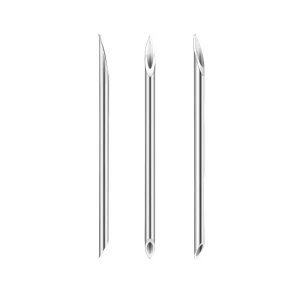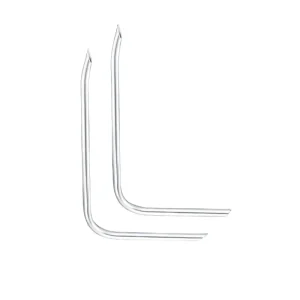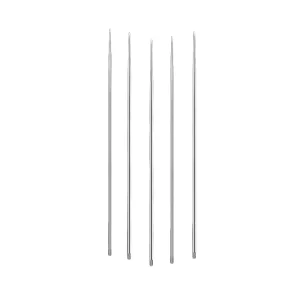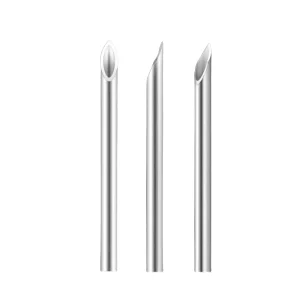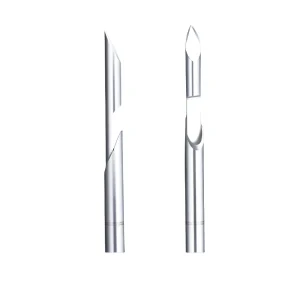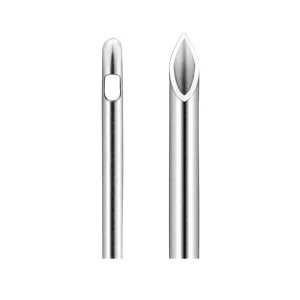








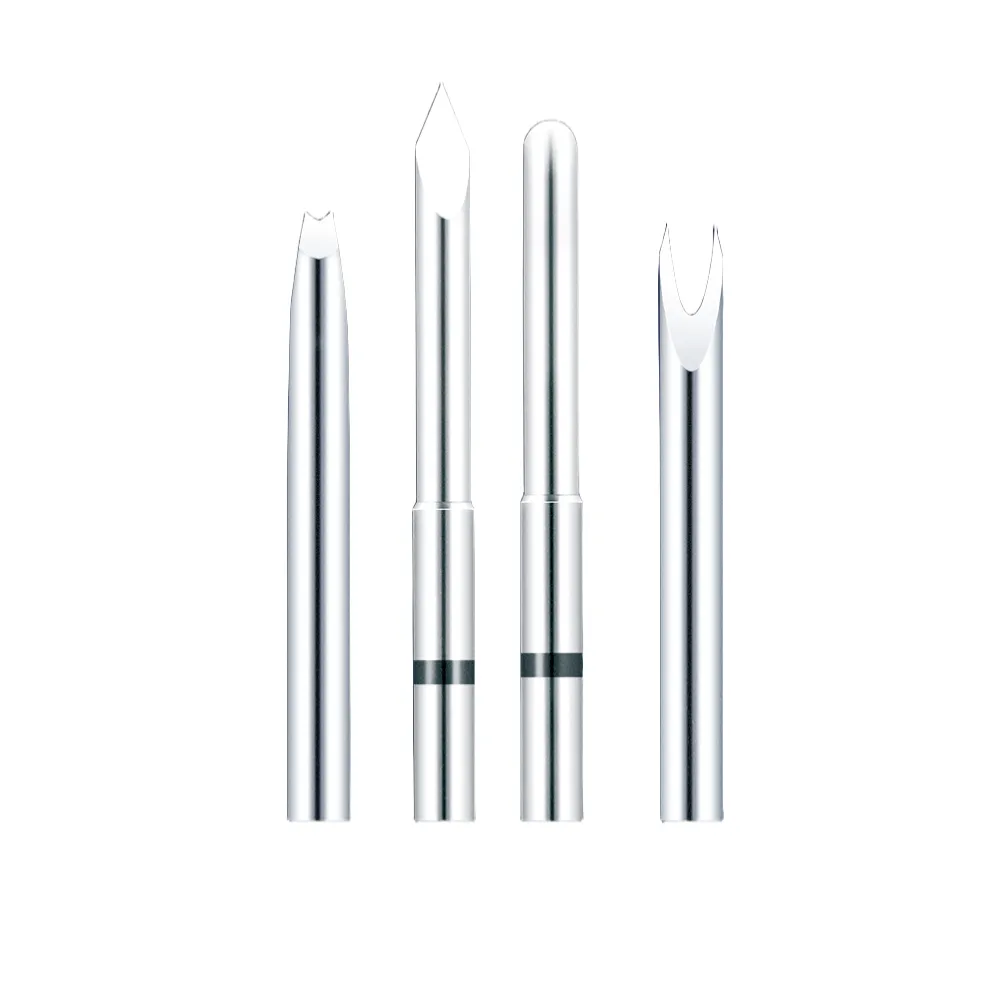
Coaxial Needle 17G, 18G
Coaxial Needle Product Introduction:
1. It has fine workmanship. When it penetrates the skin, the blade is firm and sharp.
2 . Clear tick mark and controllable puncture depth.
3. The tail of the outer cannula can be flared and frosted, and the tail of the needle core can be flattened (marked).
Product Specification:
Specification: 10G-22G 0D:3.4mm-0.7mm
SPECIFICATIONS
Technical Parameters
Technical Specifications
| Parameter | Value / Description |
|---|---|
| Product Name | Coaxial Needle |
| Available Gauges | 10G – 22G |
| Highlighted SKUs | 17G, 18G |
| Outer Diameter (OD) | 3.4 mm (10G) – 0.7 mm (22G) |
| Material – Cannula | Medical-grade SUS304 stainless steel (ISO 9626 compliant) |
| Material – Hub | Medical-grade polymer with ergonomic design |
| Design | Outer cannula + inner stylet (coaxial structure) |
| Bevel / Blade | Precision-ground, firm and sharp, low insertion resistance |
| Depth Control | Laser-etched or engraved tick marks on cannula surface |
| Tail Design – Cannula | Flared or frosted finish for better grip |
| Tail Design – Stylet | Flattened or marked for orientation |
| Connection Type | Luer-lock compatible |
| Sterilization Method | EO (Ethylene Oxide) sterilized |
| Packaging | Individually sterile blister packs; 10–50 pcs per box |
| Single-Use | Yes |
| Certification | ISO 13485, CE marking, FDA registration (region dependent) |
| Shelf Life | 3–5 years under recommended storage conditions |
Coaxial Needle: Precision Layered Access for Image-Guided Interventions.
Coaxial Needle Clinical Purpose
Engineered for sequential instrument deployment during complex biopsies and ablations, our coaxial system establishes a stable access tract through which multiple devices (biopsy guns, RF probes, cryoapplicators) can be introduced with a single tissue penetration. Eliminates repeated punctures to preserve sample integrity and reduce complications.
Coaxial Needle Key Advantages
Dual-Stage Precision
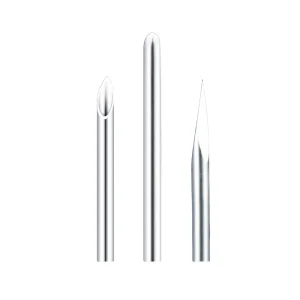
Trocar-tipped inner stylet: Ultra-bevelled 12° cutting edge (HRC 58±2 hardness) ensures clean initial penetration.
Bevel-matched outer cannula: Mirror-polished interior (Ra ≤0.1μm) advances smoothly over stylet with zero tissue drag.
Procedural Control
Laser-etched depth markers (1mm graduations) enable millimeter-accurate placement under CT/ultrasound.
Frosted/flared cannula hub provides a positive-lock grip during device exchanges.
Traceability & Safety
Flat-marked stylet base: Visual/tactile orientation confirms rotational alignment.
The tapered transition zone prevents fluid leakage at the hub junction.
Advanced Material Engineering
Cannula: Seamless SUS 304 stainless steel (ASTM F899 compliant).
Surface: Electropassivated exterior, Hydrophilic coating option.
Hub: MRI-safe polycarbonate with Luer-Lock.
Critical Applications
Multi-pass bone tumor biopsies.
Liver/kidney ablation probe placement.
Lung nodule fiducial marker deployment.
Seeding brachytherapy catheters.
FEATURES
Customization Advantages
Precision engineering for complex medical applications
Geometry Expertise
J-hooks, helical coils, side ports, multi-lumen structures, or patient-specific bends. Micro-barb retention elements, fluid channels (≥50μm ID), or directional drug delivery windows.
Advanced Manufacturing
Laser micromachining precision ±5μm. Electroforming for seamless tapered transitions. Nitinol shape-memory integration for steerable functionality.
Rapid Prototyping
Surgical-grade steel / PEEK 3D-printed prototypes delivered within 72 hours. CFD and structural simulation reports to accelerate product validation.
Ready to Discuss Your Custom Requirements?
RELATED PRODUCTS
Related Products
Related products
FAQs
Q: What is a coaxial needle?
A: A set of coaxial biopsy needles permits repeated tissue samples through an outer, larger needle that remains in place. The tract can be dilated from 23 to 16 gauge with the use of transfer rods, without loss of the initial position.
Q: What size needle is used for coaxial biopsy?
A: It is usually obtained as a set. For example, it may be a combination of a 17G outer guiding needle that comes with its own stylet and an 18G biopsy needle. The commonly available lengths are 9 and 15 cm.
Q: What is the coaxial technique for renal biopsy?
A: Real-time USG-guided biopsy can be performed using either coaxial or non-coaxial techniques. In the coaxial technique, a guide coaxial needle is inserted into the target organ, and more than 1 tissue sample is collected by passing a biopsy needle through the guide needle without changing its location.
GET A FREE CONSULTATION