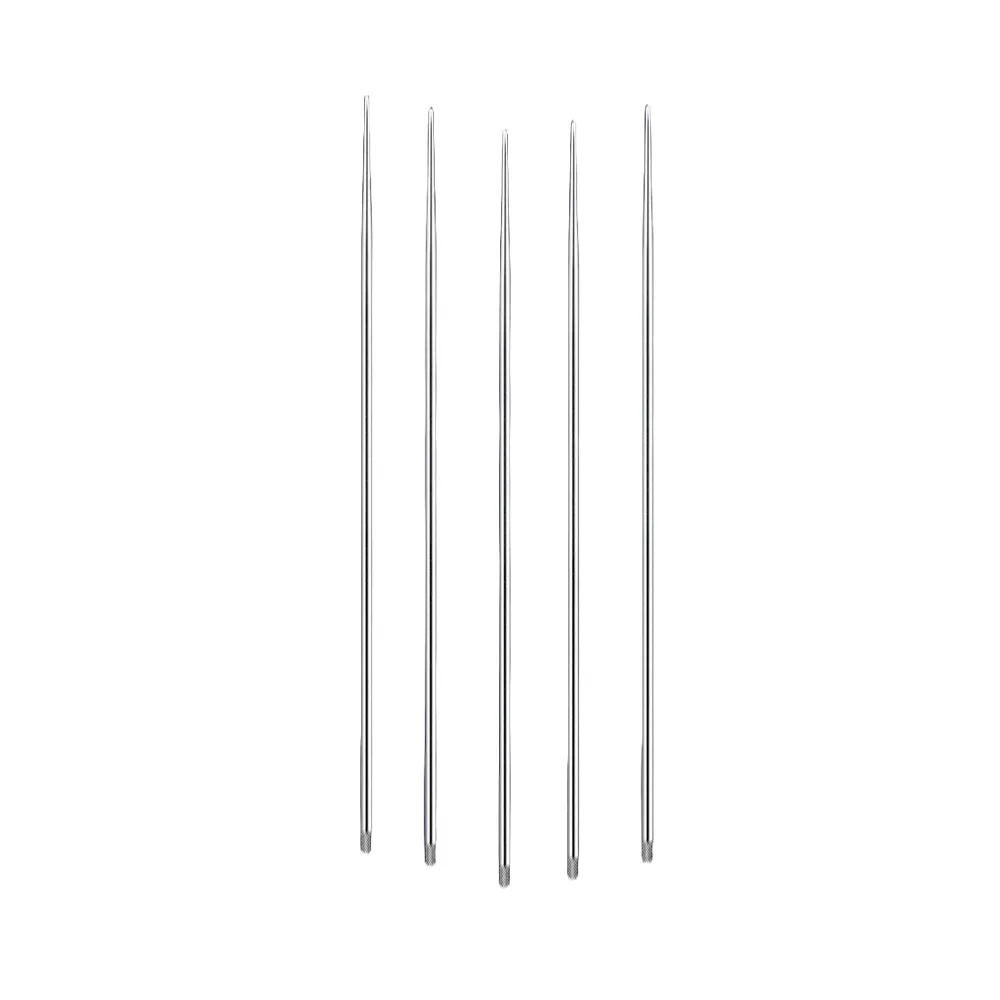
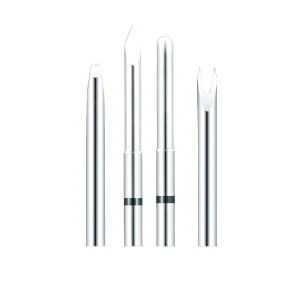
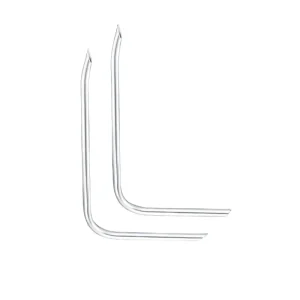
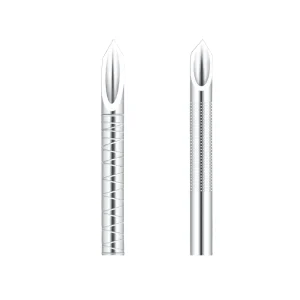
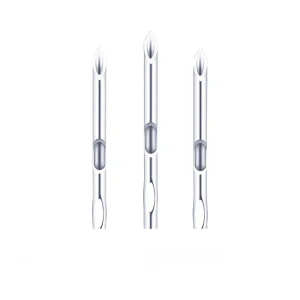
Subcutaneous Tunnel Needle
SPECIFICATIONS
Technical Parameters
Technical Specifications
| Parameter | Specification |
|---|---|
| Product Name | Subcutaneous Tunneling Needle |
| Material – Cannula | Medical-grade SUS304 stainless steel (ISO 9626 compliant) |
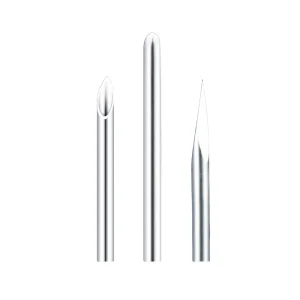
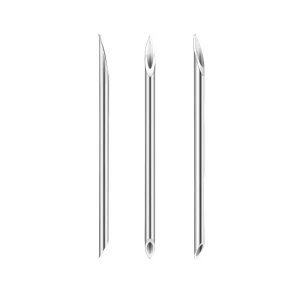
| Tip Design | Radial-symmetry blunt dome (non-coring) for atraumatic passage |
| Outer Diameter (OD) | 1.2 mm – 3.0 mm (customizable per clinical application) |
| Length Options | 200 mm – 500 mm (±0.5 mm tolerance) |
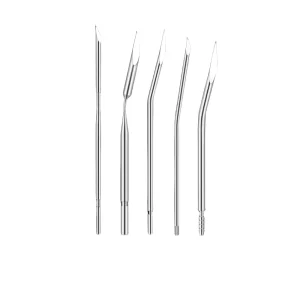
| Curvature Options | Straight / 15° angled / 30° angled pre-formed |
| Surface Finish | Polished, low-friction, biocompatible coating available |
| Hub / Handle Options | Pagoda-type, knurled, or textured anti-slip designs |
| Transition Zone | Natural smooth taper between shaft and tip to minimize resistance |
| Sterilization Method | Ethylene Oxide (EO) sterilized |
| Packaging | Individually sterile blister pack, 10–20 units per box |
| Single-Use | Yes |
| Certifications | ISO 13485, CE, FDA (depending on region) |
| Shelf Life | 3–5 years under controlled storage conditions |
Subcutaneous Tunnel Needle: Precision Blunt Dissection for Safe Catheter Placement.
Subcutaneous Tunnel Needle Clinical Purpose
Engineered for creating controlled subcutaneous pathways in vascular access procedures, our tunnel needle enables the atraumatic placement of tunneled catheters (PICC, Hickman, and dialysis catheters) and implantable ports, while minimizing tissue damage and infection risks.
Key Advantages
Atraumatic Blunt-Tip Design
Radial-symmetry rounded tip prevents vessel/organ perforation during dissection.
A gradual variable-diameter transition eliminates abrupt step-downs, providing smooth tissue separation.
Enhanced Procedural Control
Medical-grade knurled/pagoda tail grips ensure slip-resistant handling (even with blood/fluid exposure).
Optimized shaft rigidity maintains curve integrity during tunneling.
Patient Comfort
Mirror-polished surface (Ra ≤0.1μm) reduces tissue drag by 60% versus standard needles.
Tapered OD progression minimizes tunnel tract trauma (validated VAS pain score ≤1.5/10).
Premium Material Construction
Core Shaft: Seamless SUS 304 stainless steel (ASTM F138 compliant).
Tip: Work-hardened blunt dome (0.8mm radius) with electropolished finish.
Tail Options:
Pagoda connector: Luer-Lock compatible.
Knurled grip: Diamond-pattern texturing (0.3mm depth).
Critical Applications
-
Tunneled hemodialysis catheter placement
-
Implantable venous port fixation
-
PICC line subcutaneous anchoring
-
Neurostimulator lead routing
Quality & Compliance
-
Sterile EO gamma processed │ ISO 13485 │ CE MDR Class I
-
Passivated surface (per ASTM A967), Single-use blister packaging
-
Customization: Radiopaque markers, Depth graduations
FEATURES
Customization Advantages
Precision engineering for complex medical applications
Geometry Expertise
J-hooks, helical coils, side ports, multi-lumen structures, or patient-specific bends. Micro-barb retention elements, fluid channels (≥50μm ID), or directional drug delivery windows.
Advanced Manufacturing
Laser micromachining precision ±5μm. Electroforming for seamless tapered transitions. Nitinol shape-memory integration for steerable functionality.
Rapid Prototyping
Surgical-grade steel / PEEK 3D-printed prototypes delivered within 72 hours. CFD and structural simulation reports to accelerate product validation.
Ready to Discuss Your Custom Requirements?
RELATED PRODUCTS
Related Products
Related products
FAQs
Q: What is inserted into a subcutaneous pocket?
A: Implantable devices such as subcutaneous ports provide long-term intravenous access in patients. These devices are placed subcutaneously and are connected to the central circulation by a catheter that is inserted either in the internal jugular or subclavian vein.
Q: What is a subcutaneous catheter?
A: An indwelling subcutaneous catheter is a small plastic tube that is put into this tissue, so medicine can be given several times with only one “poke.” It looks like an IV but goes under the skin instead of into the vein. After the catheter is put in, the needle inside it is removed.
Q: What should I avoid with a tunneled catheter?
A: Avoid arm and upper body movements that may pull on the catheter. These movements include heavy weight lifting and vigorous use of your arms. You will probably need to take 1 day off from work and will be able to return to normal activities shortly after.
GET A FREE CONSULTATION